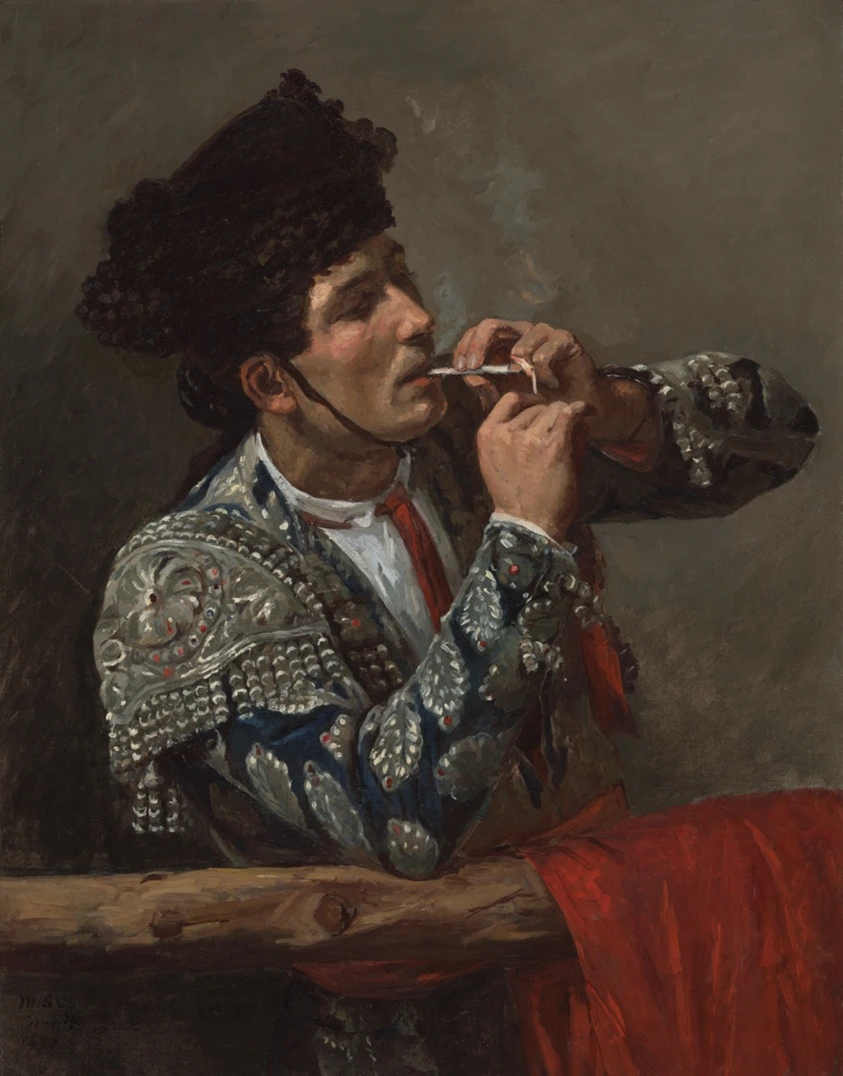
After the Bullfight

Description

Mary Cassatt chose a quintessentially Spanish subject, executing this composition of a bullfighter, or torero, in full regalia during an extended stay in Seville. Having trained in Philadelphia and Paris, Cassatt ventured to Spain to study the country’s Renaissance and Baroque works and to follow the path of French avant-garde artists like Édouard Manet. Depicting the performer at a relaxed moment, far removed from the spectacle and violence of the ring, Cassatt omitted narrative detail. Instead, with a modernist sensibility, she focused on the male figure in a casual pose, employing vigorous brushwork and rich pigment to describe the bullfighter’s costume and suggest his characteristic bravado.

Provenance

The artist, 1873; H. Teubner, Philadelphia, by 1878; John Ruderman, Montclair, NJ, dates unknown; Mr. and Mrs. Lewis Padawar, NY, until c. 1957; John Cunningham, New York, by September 1959; Hirschl & Adler Galleries, Inc., New York, September 1959; Mrs. Sterling Morton (1890-1969), Chicago, October 26, 1959; bequeathed to the Art Institute of Chicago, 1969.

After the Bullfight

Mary Cassatt

1873

Accession Number

31816

Medium

Oil on canvas

Dimensions

82.5 × 64 cm (32 1/8 × 25 3/16 in.)

Classification

Painting

Museum

The Art Institute of Chicago

Chicago, United States

Credit Line

Bequest of Mrs. Sterling Morton

Background & Context

Background Story

"After the Bullfight" is an 1873 oil on canvas by Mary Cassatt that documents the American artist's early engagement with Spanish subject matter, the image showing a woman in traditional Spanish dress in a pose and setting that suggest both the spectacle of the bullring and the private aftermath of public drama. The composition is a full-length portrait, the figure rendered with the bold, direct brushwork that characterized Cassatt's early style before she fully embraced Impressionism, the colors rich and saturated—the reds and blacks of Spanish costume against the warm browns of the background. The 1873 date places this work in the period of Cassatt's first European travels and her study of the Old Masters in Spain and Italy, the Spanish subject reflecting both the influence of her teacher Thomas Eakins and her own interest in the exotic and the theatrical. Art historians have connected this painting to the broader tradition of Spanish imagery in nineteenth-century art, from the Gypsy subjects of Fortuny to the bullfight paintings of Manet, noting that Cassatt's treatment is more focused on the female figure and the aftermath of the event rather than the violence and spectacle of the bullfight itself. The work also demonstrates the technical assurance of Cassatt's early career: the handling of the complicated costume, the confident brushwork, and the solid construction of the figure all suggest an artist who had already mastered the fundamentals of academic painting before she began to challenge them.

Cultural Impact

This 1873 oil canvas explored pre-Impressionist Spanish exotic aftermath through bold saturated red-black costume directness, using full-length academic construction to make female post-bullfight private drama distinct from Manet's violent spectacle tradition.

Why It Matters

It matters because Cassatt painted a woman after the bulls and made her look like she was still hearing the crowd—proving that even the quiet after spectacle could be vivid if the red was deep enough.