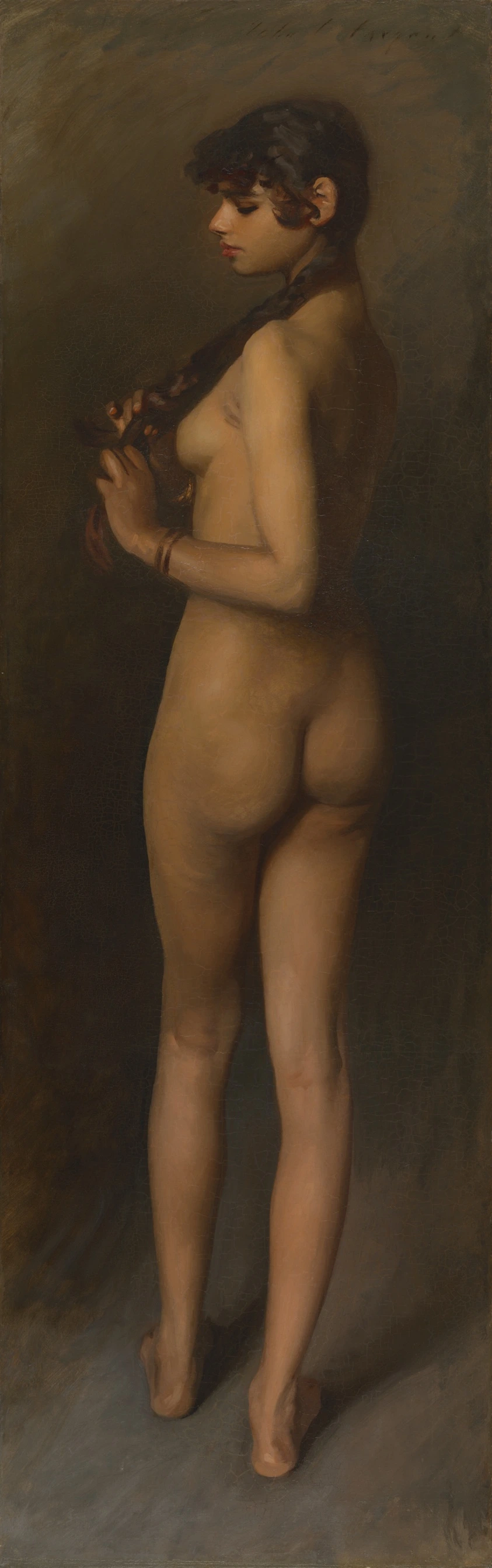
Life Study (Study of an Egyptian Girl)

Description

John Singer Sargent traveled to Egypt in 1891 in search of source material for a mural commission for the Boston Public Library. Like many 19th-century Western European artists, he was drawn to the Middle East by the region’s perceived exoticism and its ancient histories. The identity of the woman who posed in Cairo for this full-length figure study is not known. She assumes a complicated posture, placing her weight on her right foot while twisting her upper body to the left. Instead of using the bravura painterly style of swift, visible brushstrokes that characterizes his society portraits, Sargent returned to his academic training, carefully modeling the human form and a range of flesh tones. Life Study was widely exhibited, including at the World’s Columbian Exposition in Chicago in 1893.

Life Study (Study of an Egyptian Girl)

John Singer Sargent

1891

Accession Number

121629

Medium

Oil on canvas

Dimensions

190.5 × 61 cm (75 × 24 in.)

Classification

Painting

Museum

The Art Institute of Chicago

Chicago, United States

Credit Line

Anonymous loan

Background & Context

Background Story

"Life Study (Study of an Egyptian Girl)" is one of Sargent's most exotic full-length studies, painted in 1891 during the period when he was traveling through Egypt and the Middle East in search of subjects that would satisfy his patrons' appetite for the Orientalist imagery that had been fashionable since Delacroix and Gérôme. The composition shows a young Egyptian woman standing in an interior, her body wrapped in traditional dress that reveals only her face, hands, and feet, the rest concealed in dark fabric that frames her form against a neutral background. The scale is unusually tall and narrow—190.5 × 61 centimeters—creating a columnar format that emphasizes the figure's vertical dignity and echoes the proportions of ancient Egyptian statuary. Sargent's brushwork is characteristically fluid: the face is modeled with delicate precision while the drapery is rendered in broad, confident strokes that suggest the weight and texture of the fabric without describing every fold. The palette is restricted to warm browns, creams, and the deep blacks of the costume, creating a tonal harmony that recalls Whistler's arrangements while maintaining the descriptive clarity that Sargent's society portraits demanded. The painting also reflects Sargent's complicated relationship with Orientalism: he shared the era's fascination with non-Western subjects while maintaining a respectful distance from the more exploitative conventions of the genre. Art historians have compared this work to the Orientalist paintings of his contemporary Frederick Arthur Bridgman, noting that Sargent's treatment is more painterly, less ethnographically precise than the academic Orientalists. The canvas also belongs to Sargent's personal collecting practice: he produced numerous such studies during his travels, many of which remained in his studio rather than being exhibited or sold.

Cultural Impact

This 1891 Orientalist study combined ancient Egyptian statuary proportions with Whistlerian tonal harmony, documenting Sargent's personal collecting practice while navigating the genre's exploitative conventions.

Why It Matters

It matters because Sargent painted a woman in Cairo like she was a column—proving that even Orientalist fantasy could find dignity in vertical proportions.