The Essex Canal

Description

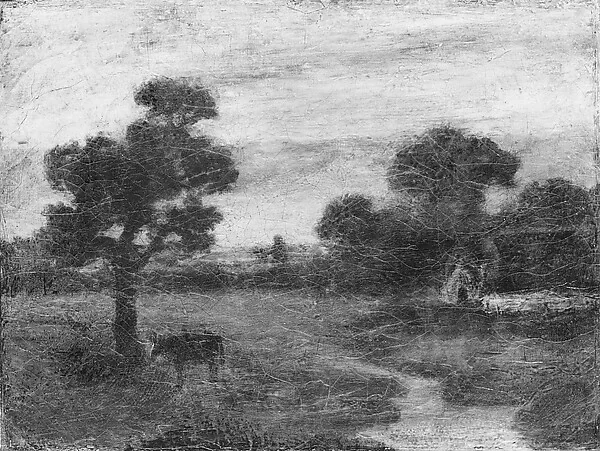
Albert Pinkham Ryder was one of the most innovative artists of the late 19th century, creating reductive, yet expressive compositions out of thick, slowly worked paint, combined with glazes, varnishes, and unconventional materials. In The Essex Canal, a waterway faintly meanders from the green-hued foreground to a skim of blue along the horizon, with an expansive sky beyond. A younger generation of American artists celebrated Ryder as an important early modernist, who pushed toward abstraction and focused on the arduous process of painting itself as instrumental to one’s creative vision. Ryder’s reclusiveness only added to his intrigue and mythic status as an artist ahead of his time.

Provenance

John Gellatly, New York, by 1918. Charles Melville Dewey, by 1932; Anderson Galleries, American Art Association sale (Dewey estate); April 8, 1937; Ferargil Galleries, New York, 1937. Jesse Sobol, New York, 1951. Parke-Bernet Galleries, New York, sale, November 15, 1967; Herbert Geist, Chicago, 1967; given by him to the Art Institute of Chicago, 1980.

The Essex Canal

Albert Pinkham Ryder

c. 1896

Accession Number

60239

Medium

Oil on canvas mounted on board

Dimensions

41.3 × 52.1 cm (16 1/4 × 20 1/2 in.)

Classification

Painting

Museum

The Art Institute of Chicago

Chicago, United States

Credit Line

Gift of Mr. and Mrs. Herbert Geist
Background & Context

Background Story

Albert Pinkham Ryders The Essex Canal, painted around 1896, is a haunting nocturnal scene depicting a canal in Essex with Ryders characteristic atmospheric intensity and mysterious depth. The composition features a dark waterway reflecting dim light from unseen sources, the canals surface rendered in thick, layered impasto that Ryder built up over months and sometimes years of reworking. Ryder was notorious for his obsessive working process, he would return to paintings repeatedly, adding layer upon layer of paint until the surface became a dense, sculptural relief, and The Essex Canal likely underwent this extended meditation. The painting emerges from Ryders unique vision of landscape as spiritual allegory: the canal is not merely a waterway but a passage into twilight, a border zone between the material world and something more mysterious. The loose, almost apparitional handling of form anticipates aspects of 20th-century expressionism, while the mood of solitary melancholy connects Ryder to the Romantic tradition of Caspar David Friedrich and the American Luminists.

Cultural Impact

Ryder is now recognized as one of the most original figures in American art, a painter whose visionary landscapes anticipated both Symbolism and Abstract Expressionism. His tiny surviving oeuvre, perhaps only 80 to 100 paintings remain in reliable condition, makes each work a precious document of one of art historys most solitary and obsessive creative spirits.

Why It Matters

A nocturnal canal scene by Ryder that exemplifies his visionary approach to landscape, with thick impasto and mysterious atmosphere that anticipate modernist expressionism while connecting to the Romantic tradition.