Description
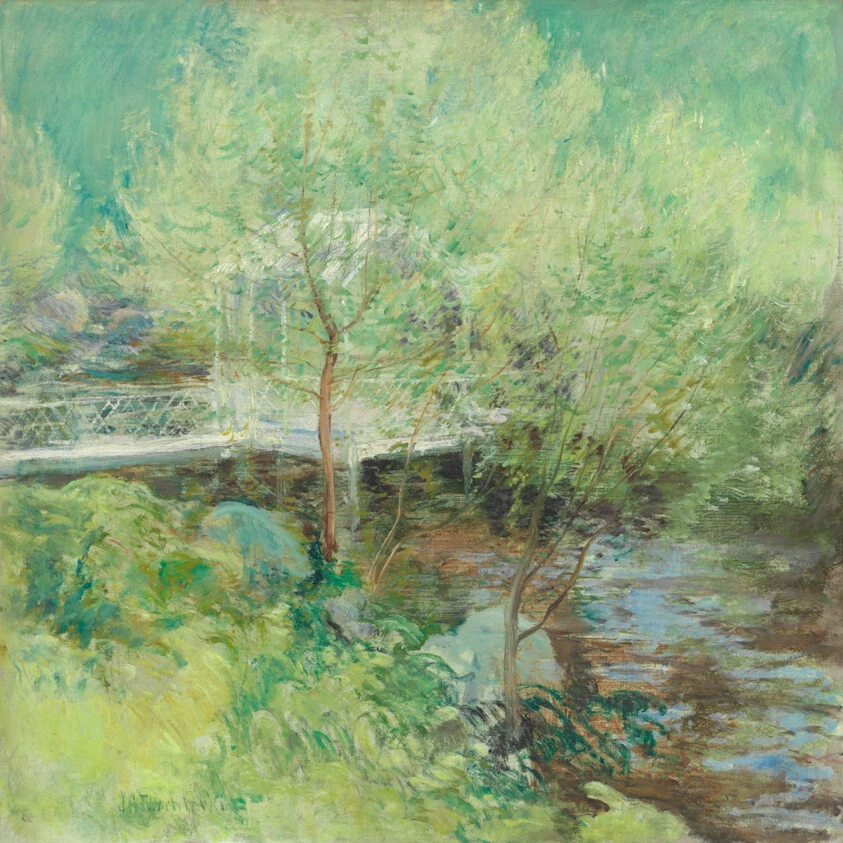
The White Bridge depicts Horseneck Brook, which traversed John Henry Twachtman's Connecticut property. The artist painted at least six versions of the bridge over the course of six years; however, its shape is slightly different in each work. Twachtman may have altered the actual bridge or simply changed its appearance in each painting. Loosely rendered with feathery brushstrokes of green and rich brown, and incorporating expanses of unprimed canvas, this scene captures the rapid growth and verdant blossoming of spring.
Provenance
Alexander Morton, New York, by 1916; American Art Galleries, New York, 1916; Macbeth Galleries, New York, 1916; sold to Martin A. Ryerson (1856–1932), Chicago, 1916; by descent to his wife Carrie Hutchinson Ryerson (1859–1937), Chicago, 1932 [Last Will and Testament of Martin A. Ryerson, Died August 11, 1932, copy in Institutional Archives, Art Institute of Chicago]; bequeathed to the Art Institute of Chicago, 1937.
Accession Number
25872
Medium
Oil on canvas
Dimensions
75 × 75 cm (29 1/2 × 29 1/2 in.)
Classification
Painting
Credit Line
Mr. and Mrs. Martin A. Ryerson Collection
Background & Context
Background Story
"The White Bridge" is an after 1895 oil on canvas by John Henry Twachtman that captures the American Impressionist painter in his most tonally unified and atmospherically enveloping mode, the image showing a bridge rendered with the same muted palette and thick, atmospheric brushwork that made Twachtman's landscapes among the most poetic works of American Tonalism. The composition is a medium-sized square canvas—75 × 75 centimeters—showing a white bridge in a winter or overcast landscape rendered with the muted greens, greys, and whites that suggest both the physical reality of the Connecticut countryside and the spiritual serenity of the artist's inner vision. The oil on canvas creates a surface of extraordinary unity and atmospheric depth, the paint suggesting both the soft light of the overcast day and the quiet melancholy of the solitary landscape. The after 1895 date places this work in the period of Twachtman's mature career in Connecticut, when he was producing the paintings that established his reputation as the leading American Tonalist and the most refined interpreter of the New England landscape. Art historians have connected this painting to the broader tradition of the tonal landscape in American art, from the works of Inness to the paintings of Whistler, noting that Twachtman's treatment is more focused on the atmospheric unity and the emotional suggestion, the transformation of observed reality into meditative poetry, than the topographical accuracy or the naturalistic observation of these other traditions.
Cultural Impact
This after 1895 oil canvas made white-bridge tonally enveloping through medium 75cm square muted green-grey-white thick brushwork and atmospheric unity, using Connecticut mature Tonalism to transform New England landscape into meditative spiritual poetry beyond Inness topographical naturalism.
Why It Matters
It matters because Twachtman painted a bridge in winter and made the canvas feel like it was wrapped in a grey wool blanket of quiet—proving that even a bridge could be a poem if the tones were muted enough.


