View of Cotopaxi

Description

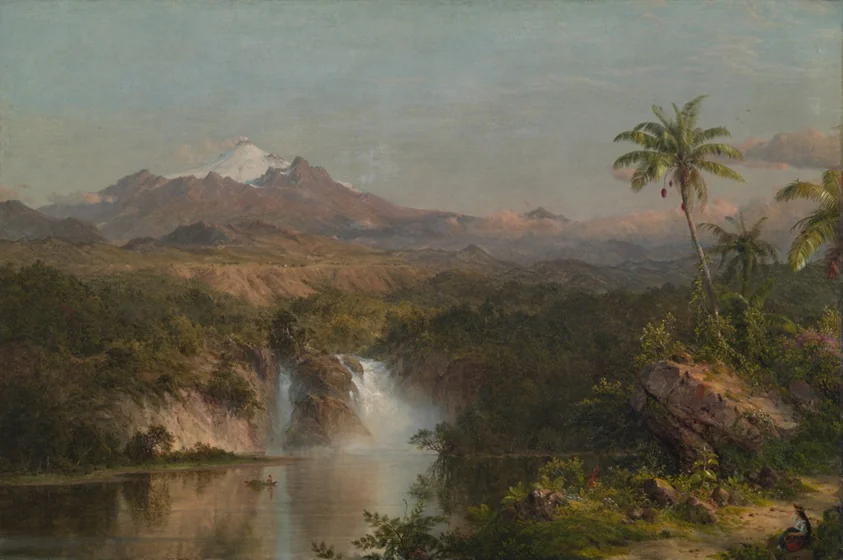
View of Cotopaxi brings together in visual form scientific, religious, political, and cultural ideas in the mid-19th century. Inspired by German naturalist Alexander von Humboldt’s concept of ecological interconnectedness, Frederic Edwin Church traveled to South America to meticulously study the tropical landscape. The artist produced at least ten finished paintings of the Ecuadorian volcano, this one completed in his studio just before his second visit to the region. For Church and other Christian viewers, nature, with all its creative and destructive wonders, was evidence of divine power. The painting likewise reflected an imperialist vision, as US government officials eyed Latin America as a site for territorial expansion and conquest.

Provenance

Walter Wright, Chicago, from 1857 to 1876; by descent to Anne E. Webster, from 1876 to 1894; by descent to Lewis Dana Webster, from 1894 to 1908; by descent to Ida Hamlin Webster, from 1908 to 1912; by descent to Mary Jennette Hamlin, from 1912 to 1919; given to the Art Institute of Chicago, 1919.

View of Cotopaxi

Frederic Edwin Church

1857

Accession Number

76571

Medium

Oil on canvas

Dimensions

62.2 × 92.7 cm (24 1/2 × 36 1/2 in.)

Classification

Painting

Museum

The Art Institute of Chicago

Chicago, United States

Credit Line

Gift of Jennette Hamlin in memory of Mr. and Mrs. Louis Dana Webster
Background & Context

Background Story

Frederic Edwin Churchs View of Cotopaxi from 1857 depicts the Ecuadoran volcano that would become the central subject of his most ambitious paintings, seen here in a relatively early treatment that already displays the artists characteristic combination of topographic accuracy and dramatic atmospheric effects. Cotopaxi, one of the highest active volcanoes in the world, had captured Churchs imagination during his 1853 trip to South America with the scientist-explorer Alexander von Humboldts writings as his guide, and he would return to the subject repeatedly over the next decade, producing increasingly dramatic compositions that culminated in the explosive Cotopaxi of 1862. In this 1857 view, the volcano emits a modest plume of smoke against a sky of extraordinary luminosity, its snow-capped cone rising from a tropical landscape rendered with the botanical detail and climatic specificity that Church derived directly from his on-site drawings. The composition is organized by the diagonal of the mountain slope and the horizontal bands of vegetation, water, and sky that create the sense of vastness and natural order that distinguishes the Hudson River School at its most ambitious. Churchs technique of building up thin glazes of oil paint to create luminous atmospheric effects reaches an early peak in this painting, where the sky glows with a peach and gold light that seems to emanate from the canvas itself rather than from an external source.

Cultural Impact

Churchs Cotopaxi paintings are among the most iconic images of the Hudson River School and of 19th-century American landscape painting generally. They established a model for the depiction of the sublime in nature that influenced the entire tradition of American landscape art and helped create the visual vocabulary through which Americans understood the natural wonders of the Western Hemisphere.

Why It Matters

A luminous early treatment of the Ecuadoran volcano by Church, combining topographic accuracy with atmospheric spectacle and demonstrating the thin-glaze technique that would make his paintings of Cotopaxi among the most iconic images of the Hudson River School.