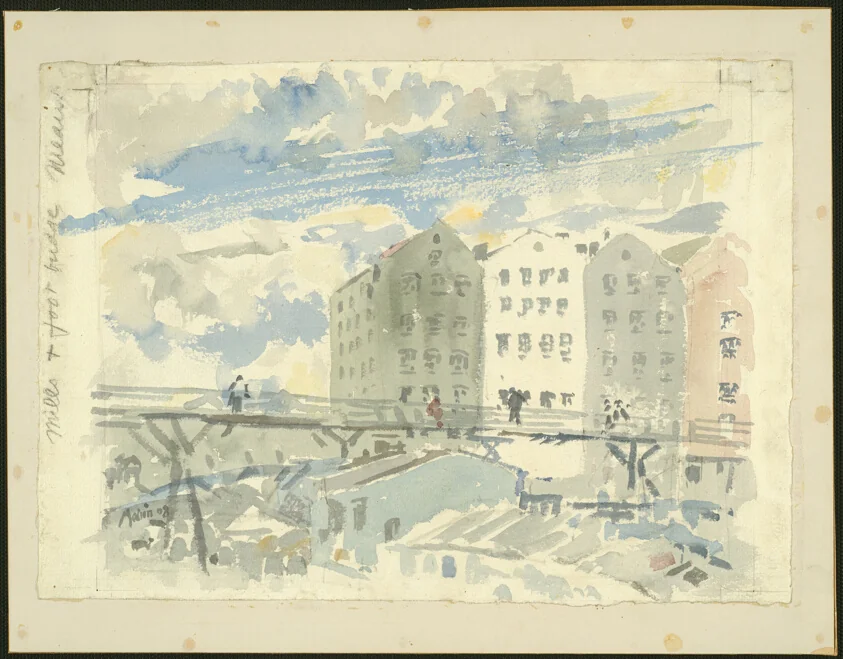
Mills and Footbridge, Meaux

Description

Marin made repeated trips to Meaux, an old mill town 25 miles northeast of Paris. Here dabs of diluted pink, red, and yellow suggest the movement of clouds, figures, and wind. Marin painted the sky with long, dry brushstrokes, then defined the clouds, working wet-into-wet by dripping in dilute washes of color that dispersed the pigment and yielded dark, feathered lines. After the washes dried, he punctuated the remaining white of the sky with yellow marks to add brightness. Demonstrating an intuitive understanding of how watercolor behaves, as well as a willingness to experiment with unpredictable results, Marin found such manipulations liberating. This was among the 25 watercolors shown at Stieglitz’s 291 in the spring of 1909, the first time the gallery owner exhibited Marin’s work.

Provenance

Alfred Stieglitz (1864–1946), New York; Stieglitz Estate (Georgia O'Keeffe (1887–1986), executor); given to the Art Institute of Chicago, 1956.

Mills and Footbridge, Meaux

John Marin

1908

Accession Number

2915

Medium

Watercolor with touches of blotting, over traces of graphite, on lightweight, moderately textured, ivory wove paper, laid down on off-white wood-pulp laminate board

Dimensions

28.3 × 39.1 cm (11 3/16 × 15 7/16 in.)

Classification

watercolor

Museum

The Art Institute of Chicago

Chicago, United States

Credit Line

Alfred Stieglitz Collection

Background & Context

Background Story

"Mills and Footbridge, Meaux" is an early watercolor from 1908, painted during John Marin's first extended stay in France, when he was absorbing the lessons of Cézanne and the Fauves while searching for a personal approach to watercolor that would distinguish him from European contemporaries. The composition shows an industrial scene—a mill building with a footbridge crossing a canal or stream—rendered with the delicate touch that characterized Marin's pre-war work, before the boldness of his Maine period. The watercolor medium is handled with transparent washes over graphite underdrawing, the architecture described with careful perspective and the water suggested by horizontal strokes that reflect the sky and surrounding foliage. This early discipline is important because it demonstrates that Marin's later abstraction was not ignorance of traditional technique but a deliberate departure from it; he had mastered representation before abandoning it. The subject itself—an industrial waterway near the town of Meaux—connects Marin to the broader tradition of French landscape painting that stretched from Corot to Sisley, though his treatment is more graphic, less atmospheric than the Impressionists. The touches of blotting mentioned in the medium description create soft edges and accidental textures that suggest the humidity of the French countryside, a technique Marin would develop into his mature method of controlled accident. Art historians have linked this work to the American expatriate community in Paris, where Marin was part of a circle that included Stein, Picasso, and Alfred Stieglitz, the dealer who would later become his most important promoter.

Cultural Impact

This early French watercolor demonstrated Marin's traditional mastery before his later abstraction, documenting the rural-industrial Meaux landscape with transparent washes and controlled blotting.

Why It Matters

It matters because Marin learned to draw a bridge properly before he learned to paint one exploding—proving that revolution requires apprenticeship.