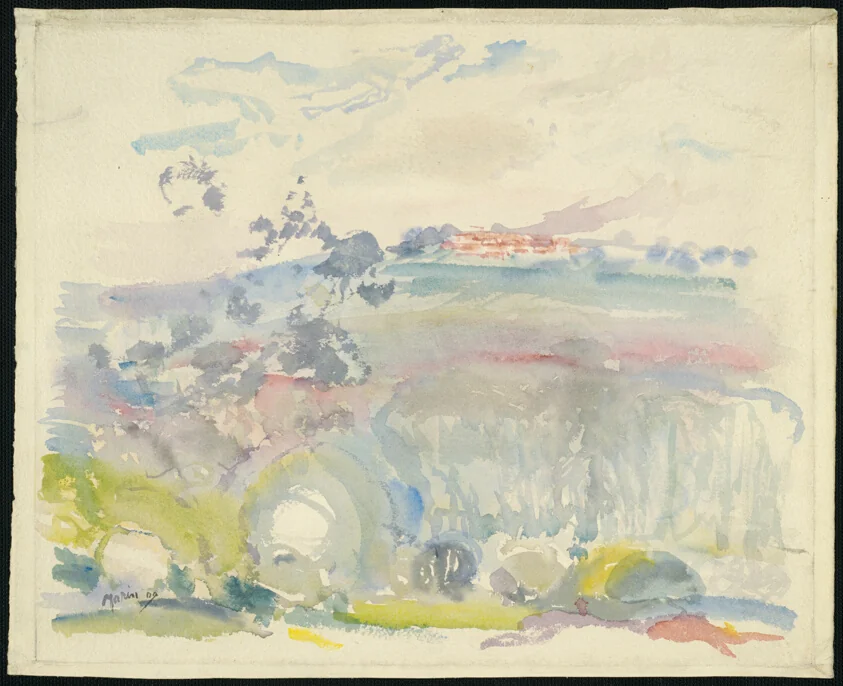
Spring (Montbarbin)

Description

Shown at Stieglitz’s New York gallery in 1910, this delicate yet energetic work is one of several landscapes that Marin painted in the Seine-et-Marne region east of Paris. Set among lush rolling meadows, the distant village of Montbarbin was rendered by staining wet paper with pale washes of green-gray and pink. The artist used stronger washes to suggest the contours of rocks and boulders in the foreground, and rapid brushstrokes to indicate the movement of air and clouds. Marin completed this watercolor by dabbing shapes in a darker gray wash on the left with a crumpled rag, approximating the fluttering leaves of a small tree. These untethered blots seem to be borne aloft by the energy of buffeting breezes.

Provenance

Alfred Stieglitz (1864–1946), New York; Stieglitz Estate (Georgia O'Keeffe (1887–1986), executor); given to the Art Institute of Chicago, 1956.

Spring (Montbarbin)

John Marin

1909

Accession Number

2919

Medium

Watercolor with blotting and rewetting, on lightweight, slightly textured, off-white wove paper (top and lower edges trimmed)

Dimensions

35.3 × 43.3 cm (13 15/16 × 17 1/16 in.)

Classification

watercolor

Museum

The Art Institute of Chicago

Chicago, United States

Credit Line

Alfred Stieglitz Collection

Background & Context

Background Story

"Spring (Montbarbin)" is a radiant watercolor from 1909, executed during Marin's second French sojourn in the village of Montbarbin, where he spent months painting the countryside with the plein-air immediacy that would become his signature. The composition shows a typical French rural spring scene—blossoming trees, new foliage, and the pale green light that precedes the full verdure of summer—rendered with the blotting and rewetting techniques that Marin was developing to create atmospheric depth without heavy pigment. The medium of watercolor on lightweight wove paper allows the artist to work quickly, capturing the transient effects of morning light before they shift into afternoon clarity. This responsiveness to natural change is what distinguishes Marin from more studio-bound watercolorists; his sheets carry the physical evidence of outdoor execution, from wind-blown pigment to accidental water marks that the indoor painter would have eliminated. The palette is high-keyed and buoyant, with yellows, pale greens, and touches of rose that suggest the chromatic optimism of spring rather than describing specific flowers or fields. Art historians have connected this work to the broader Fauve interest in pure color unleashed from descriptive duty, though Marin's treatment is more restrained than Derain's or Vlaminck's. The painting also documents a crucial moment in Marin's biography: 1909 was the year before his return to America, and these French landscapes represent the last phase of his European apprenticeship before he committed himself to the American subjects that would make his reputation.

Cultural Impact

This 1909 plein-air watercolor captured French spring light through blotting and rewetting techniques, marking the final phase of Marin's European apprenticeship before his American maturity.

Why It Matters

It matters because an American in a French village painted spring like it might not return—Marin learning that light was temporary while paper was forever.