Provenance
Gustav Englebrecht, Hamburg [Lugt 1148]. Sold by Allan Frumkin to the Art Institute, 1960.
Accession Number
12134
Medium
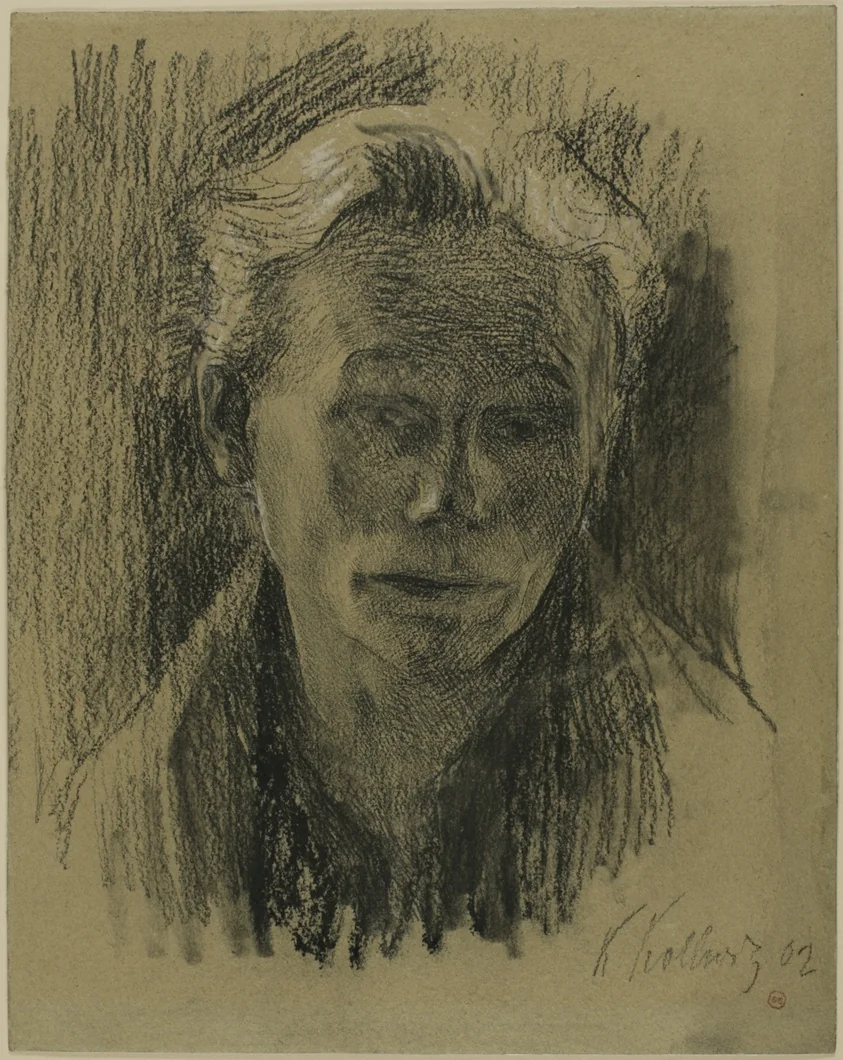
Black chalk with touches of white and pale tan chalk on brown wove paper
Dimensions
40.6 × 32.1 cm (16 × 12 11/16 in.)
Classification
charcoal
Credit Line
Herman Waldeck Memorial Fund
Background & Context
Background Story
Kathe Kollwitz's Head of a Woman (1902) is a black chalk drawing with touches of white and pale tan chalk on brown wove paper. Kollwitz (1867-1945) was a German artist known for her powerful, deeply moving depictions of the human condition, particularly the sufferings of the poor and the victims of war. This drawing of a woman's head shows the intensity and empathy that characterize all of Kollwitz's work. The features are rendered with sensitivity and strength, the eyes conveying a depth of experience and emotion. The black chalk on brown paper technique is masterful, the medium capturing the subtle modulations of light and shadow on the face. The touches of white and pale tan chalk add highlights and warmth. Kollwitz's focus on the human face as an expression of inner life is central to her art. This head of a woman could be any of the working-class women who were the subjects of her prints and drawings, bearing the marks of labor, hardship, and endurance.
Cultural Impact
Kollwitz was one of the most powerful and socially engaged artists of the 20th century, using her art to give voice to the voiceless and to protest against war and social injustice.
Why It Matters
This drawing of a woman's head captures the depth of human experience with extraordinary sensitivity and power, Kollwitz's masterful handling of the black chalk medium conveying both physical presence and inner life.


