Accession Number
16376
Medium
Oil on canvas
Dimensions
29.5 × 49.7 cm (11 5/8 × 19 1/2 in.); Framed: 40.7 × 61 × 6.4 cm (16 × 24 × 2 1/2 in.)
Classification
oil on canvas
Credit Line
Mr. and Mrs. Martin A. Ryerson Collection
Tags
Color: Orange
Background & Context
Background Story
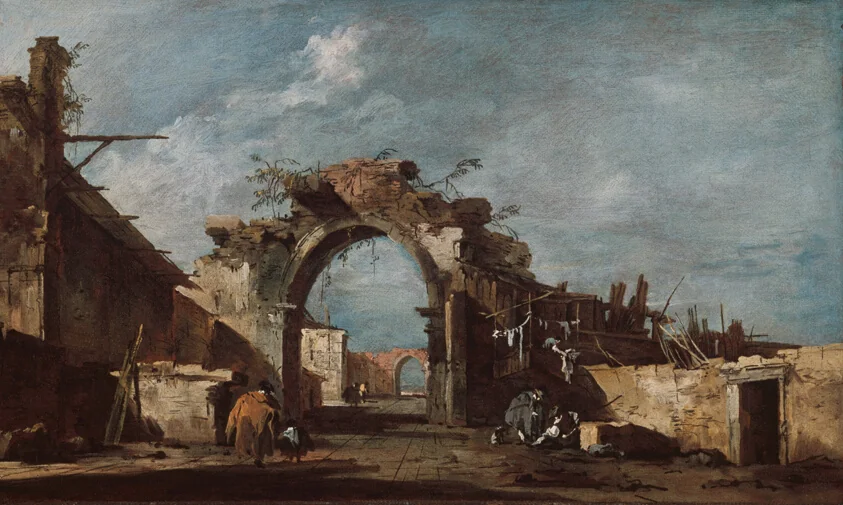
Francesco Guardi's "Ruined Archway" (1775–93) is an oil on canvas that exemplifies the artist's fascination with the picturesque ruins of the Venetian landscape. The ruined archway, perhaps a remnant of a Roman or medieval structure, stands as a picturesque element in a landscape setting. Guardi's treatment is atmospheric and evocative, the archway rendered with loose, broken brushwork that captures the texture of ancient stone and the play of light across its surface. The palette is warm and earthy, with touches of green from vegetation growing among the ruins. Figures—perhaps travelers or local residents—animate the scene. This painting belongs to the tradition of the capriccio, the imaginative combination of real and invented elements in a poetic landscape. Guardi's late works, painted in the final decades of his long life, show a remarkable freedom of handling that anticipates the Romantic landscape painting of the 19th century. The ruined archway, a symbol of the passage of time and the decay of civilizations, was a subject that resonated with the melancholy sensibility of the late 18th century.
Cultural Impact
Guardi's late capricci, with their increasingly free brushwork and atmospheric effects, look forward to the Romantic landscape painting of the 19th century and the Impressionism of the late 19th century.
Why It Matters
This painting of a ruined archway captures the picturesque beauty of decay, the loose brushwork and warm palette transforming a fragment of ancient architecture into a meditation on time, loss, and the beauty of ruins.
Related Artworks

Harem Scene
Francesco Guardi

A Capriccio with a Ruined Gothic Arch
Francesco Guardi

Adoration of the Shepherds (recto); Three Sketches: Buildings by Canal with Boats, Landscape with Buldings on Hillside, Buildings with Portico (verso)
Francesco Guardi

Capriccio with a Squall on the Lagoon
Francesco Guardi