Provenance
Possibly to Galerie de l’Effort Moderne, Paris, c. 1916 [according to London 1983; primary source documentation for this information has not been located to date]. With Galerie Alfred Flechtheim, Berlin, c. 1921 to at least Apr. 26, 1933 [according to London 1983, Berlin 1929, Berlin 1930, and Zurich 1933 (as lender)]; sent to Daniel Henry Kahnweiler, Galerie Simon, Paris, Nov. 1933 [Künsthaus Zürich Archive, Nov. 3, 1933]. Sent by Gustav Kahnweiler to Mayor Gallery, London, May 14, 1938 [Mayor Gallery log book, no. 2687]; taken by Gustav Kahnweiler, Sept. 26, 1938 [Mayor Gallery log book, no. 2687]. With Buchholz Gallery, New York, by 1949 [New York 1949]. Richard S. Davis, Minneapolis and New York, by Aug. 1955 [Museum of Modern Art, New York, Curt Valentin papers, III.A.12]. Possibly Ronald S. and Jo Carole Lauder, New York, until 1980 [according to London 1983; primary source documentation for this information has not been located to date]. John and Paul Herring Company, Inc., New York, by 1980; sold to the Art Institute of Chicago, 1980.
Accession Number
59828
Medium
Graphite on ivory laid paper
Dimensions
39.5 × 30.7 cm (15 9/16 × 12 1/8 in.)
Classification
graphite
Credit Line
Margaret Day Blake Fund Income
Background & Context
Background Story
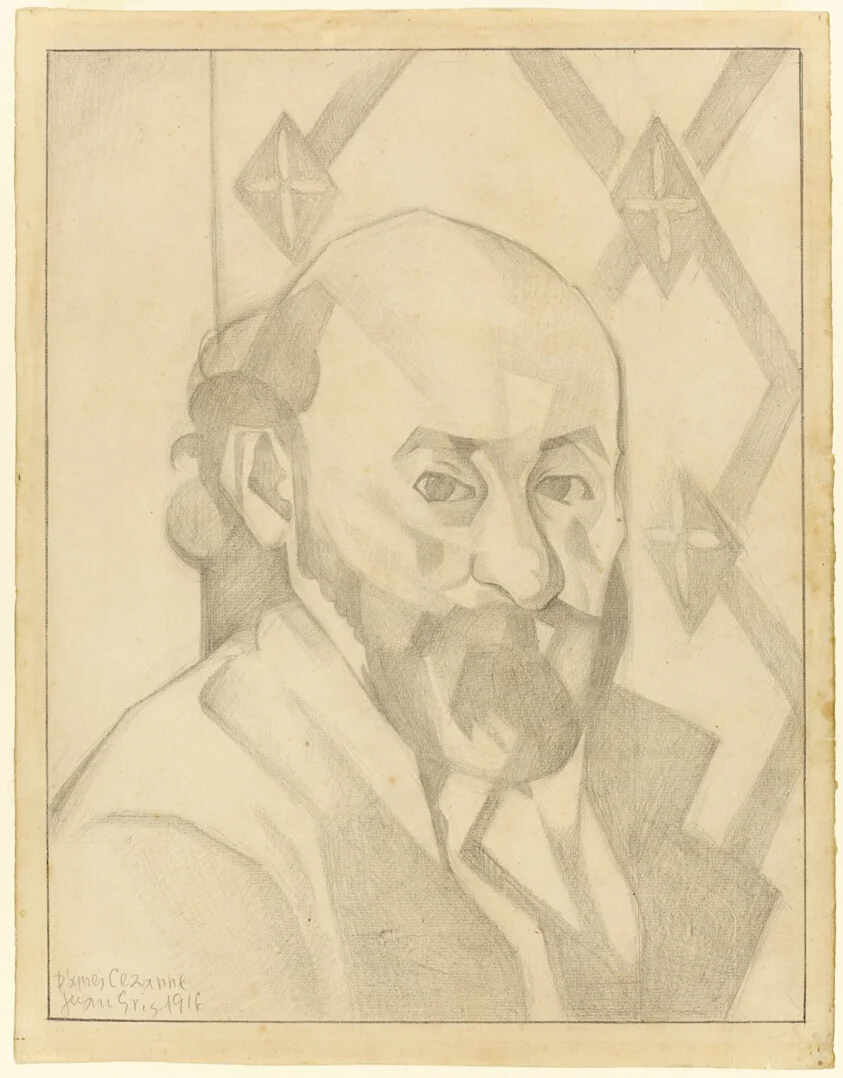
Juan Gris's After Cézanne (1916) is a graphite drawing on ivory laid paper that pays homage to Paul Cézanne, the Post-Impressionist master whose work was a crucial influence on the development of Cubism. The title indicates that the drawing is a study after a work by Cézanne, perhaps one of his still lifes or landscapes. Gris's interpretation transforms Cézanne's forms through the language of Cubism: the forms are simplified, geometrized, and analyzed according to Cubist principles. The graphite technique is precise and controlled, the lines defining the forms with clarity and economy. The ivory laid paper provides a warm, textured ground. This drawing demonstrates Gris's engagement with the tradition of French painting and his recognition of Cézanne as a crucial precursor to Cubism. The title After Cézanne acknowledges the debt that Gris and other Cubists owed to the master of Aix, whose late works had pointed the way toward the formal innovations of the 20th century.
Cultural Impact
Gris's studies after Cézanne demonstrate the Cubist engagement with the tradition of French painting, acknowledging the debt to the Post-Impressionist master who had opened the way for modern art.
Why It Matters
This graphite drawing after Cézanne pays homage to the master who transformed modern painting, Gris's Cubist interpretation translating Cézanne's forms into the language of geometric analysis.


