Provenance
Probably the artist, until 1927 [according to Madrid 1985]; Gris family (Josette Gris and Georges Gonzales Gris) [according to Madrid 1985]. Sold, Parke-Bernet Galleries, Jan. 25, 1961, lot 19. Saidenberg Gallery, New York, by Feb. 1966 [Chicago 1966]. Alice Adam Ltd., Chicago. Sold by the Thomas Borgman Gallery to Dr. and Mrs. Martin Gecht, Chicago, 1980.
Accession Number
180668
Medium
Graphite on ivory laid paper
Dimensions
39.1 × 28 cm (15 7/16 × 11 1/16 in.)
Classification
drawings (visual works)
Credit Line
Gift of the Gecht Family
Background & Context
Background Story
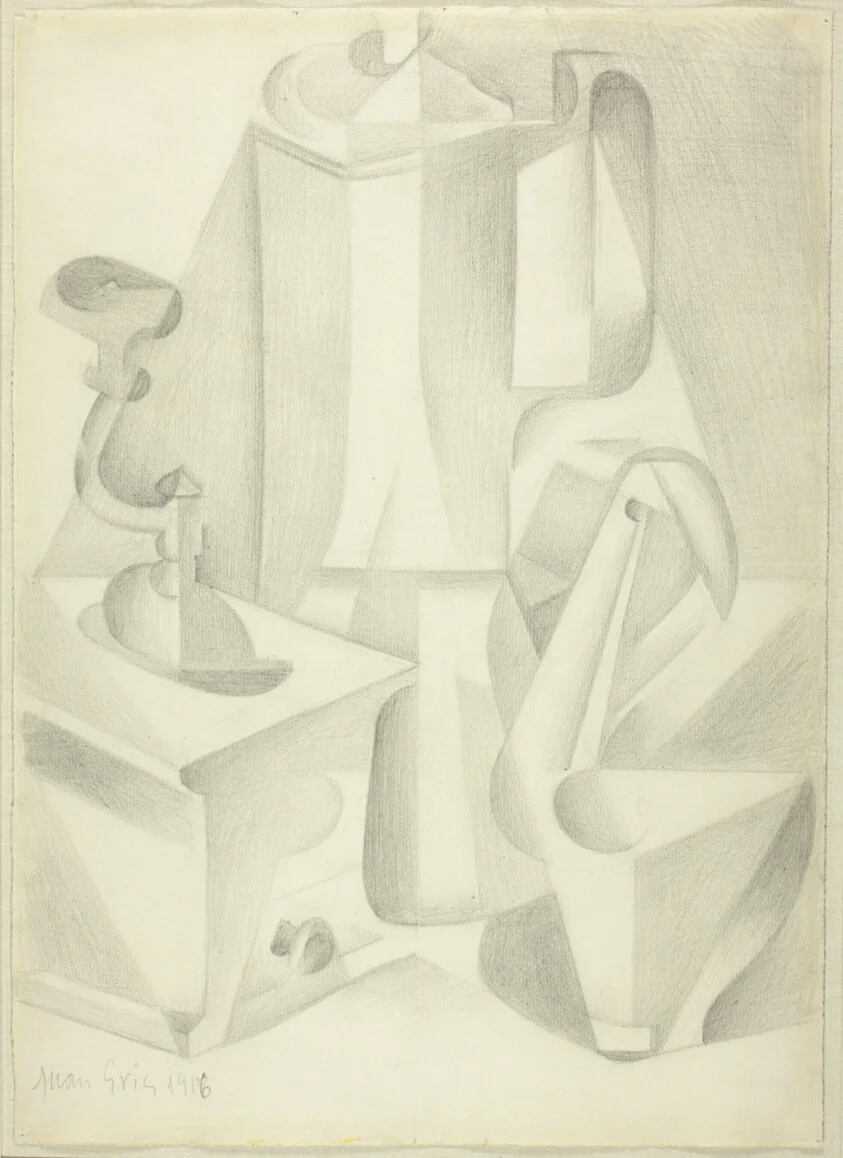
Juan Gris's Still Life with Coffee Mill (1916) is a graphite drawing on ivory laid paper that shows the Cubist approach to a traditional still life subject. The coffee mill, a common household object, is broken down and reassembled according to Cubist principles: its forms are geometrized, its space is flattened, and its relationship to the surrounding objects is analyzed and reconstructed. The graphite technique is precise and controlled, the lines defining the forms with clarity and economy. The ivory laid paper provides a warm, textured ground. This drawing belongs to the period of Gris's mature Cubism, when his style had become more systematic and structured. The still life with coffee mill is both a representation of a familiar object and a formal exercise in the analysis of form and space. Gris's approach to the subject is characteristically methodical: he breaks down the coffee mill into its component forms and reconstructs it on the paper in a new configuration.
Cultural Impact
Gris's still life drawings demonstrate the systematic approach that distinguished his Cubism from that of Picasso and Braque, showing a more methodical and intellectual engagement with the Cubist project.
Why It Matters
This graphite still life of a coffee mill transforms an everyday object through the analytical lens of Cubism, the precise lines and geometric forms creating a composition of intellectual clarity and visual complexity.


