Description
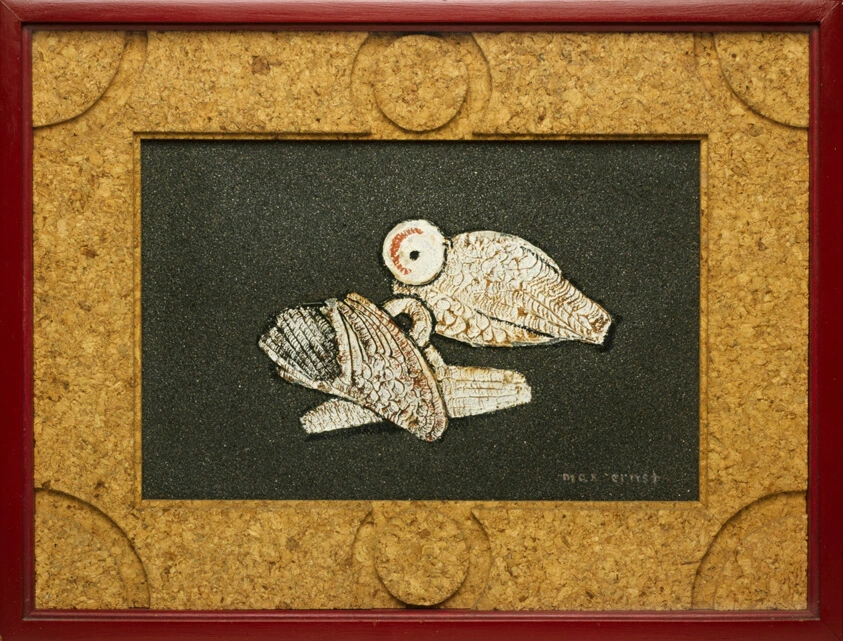
This work belongs to a group of paintings of birds, most of which were made between 1924 and 1920, according to Spies (Ernst Katalog/, vol. 2, 1975 pp. 381-91, nos. 728-50, ills.; vol. 3, 1976, p. 131, nos. 1044-45. ills.). Dated by Spies to 1924 (ibid., vol. 2, 1975. p. 381, no. 730, ill.), this work is especially close to Ernst's Birds, also of 1924, and Two Birds of around 1925 (ibid., vol. 2, 1975, pp. 385-86 nos. 738, 740, ills.), all three of which were given very similar cork frames by the artist. Although these works are generally thought to be executed on sandpaper, in this case at least, as Cynthia Kuniej Berry has observed, "close examination of the unframed painting reveals otherwise" (see Cynthia Kuniej Berry, Examination Report, August 27, 1993, in curatorial files). In her report, the painting is described as "executed on a fine lightweight, plain weave linen," on which the paint was "generously applied with active brushwork in textured, opaque masses with thick impasto," while 'the remainder of the surface is covered with a thin, even layer of sand" (ibid.). Ernst indeed applied paint thickly to create the forms of the birds and then scraped through to reveal colored layers below, employing what he called his grattage technique. The ribbed flecks of brown and black paint skillfully connote feathers. The circular heads of the birds appear in many of Ernst's works from the period, such as 100,000 Doves (1926, Paris, private collection; Ernst Katalog, vol. 3, 1976, p. 121, no. 1025, ill.), in which the circular form also is transformed into an eye or a breast. The undulation of the picture's surface seems intrinsic to the work and gives the effect of a relief, although it may have also resulted from environmental changes (see Kuniej Berry 1993 above). Ernst used similar carved cork frame, often with varying designs, in other works of the same subject (Ernst Katalog, vol. 2, 1975, pp. 385-91 nos. 738-40, 744-46, 749, 751, ills.; vol. 3, 1976, pp. 131, 136, nos. 1045, 1055, ills.).
— Entry, Dawn Ades, Surrealist Art: The Lindy and Edwin Bergman Collection at the Art Institute of Chicago, 1997, p. 126.
Accession Number
118687
Medium
Oil and sand on linen mounted on Masonite pressed-wood board, with cork frame by the artist
Dimensions
19.1 × 29.2 cm (7 1/2 × 11 1/2 in.)
Classification
Painting
Credit Line
Lindy and Edwin Bergman Collection