The Anthropomorphic Tower

Description

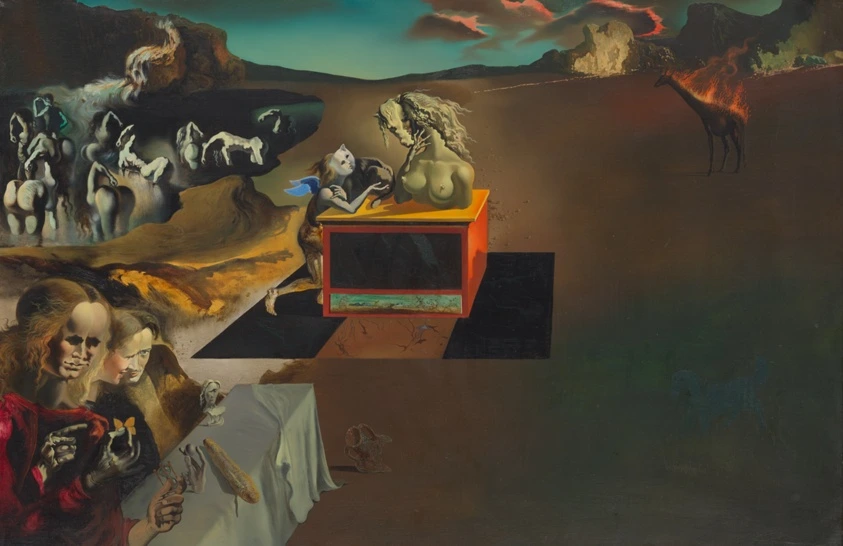
Salvador Dalí created Anthropomorphic Tower at a time in his career when he aligned himself with the Surrealists and began to produce dreamlike images charged with sexual desires and anxieties. This pastel relates to a painting of the same year called The Great Masturbator (now in the Museo nacional centro de arte Reina Sofia, Madrid). While in the painting the torso is clearly male and the head female, the pastel obfuscates each form’s sexual identity. Here the palette on the right is more subdued, in contrast with the color of the tower-penis in the upper left, which is so bright as to appear almost spot lit. Dalí used the motif several times during this period. Could the figure with closed eyes on the right be dreaming or hallucinating the image of the Anthropomorphic Tower<.em>? Dalí’s image is open to interpretation, which is at the heart of Surrealist art.

Provenance

Sold by Carstairs Gallery, New York, to Lindy and Edwin Bergman, Chicago, 1961; given to the Art Institute of Chicago, 2018.

The Anthropomorphic Tower

Salvador Dalí

1930

Accession Number

118662

Medium

Pastel and stumping on tan wove paper

Dimensions

65 × 50 cm (25 5/8 × 19 11/16 in.)

Classification

pen and ink drawings

Museum

The Art Institute of Chicago

Chicago, United States

Credit Line

Lindy and Edwin Bergman Collection
Background & Context

Background Story

"The Anthropomorphic Tower" is a 1930 pastel and stumping drawing that captures Salvador Dalí in the crucial transitional period between his early Cubist-influenced work and the fully developed Surrealist style that would make him famous. The composition shows a tower that has been transformed into a human figure, or a human figure that has become architectural, the ambiguity itself constituting the Surrealist shock that Dalí was learning to deploy with increasing sophistication. The medium of pastel on tan wove paper is significant: pastel allows both linear precision and tonal softness, the stumping technique creating smooth gradations that suggest the texture of skin and stone simultaneously. This dual texture is central to the image's meaning: the tower is both a building and a body, a public monument and a private fantasy, and the pastel medium captures this doubleness with a tactility that oil paint might have flattened. The 1930 date places this work just before Dalí's official admission to the Surrealist group and his first major Paris exhibition, suggesting that it represents the artistic breakthrough that made his subsequent success possible. Art historians have connected this image to Dalí's lifelong fascination with architecture as metaphor for the human body, from the "living room" of his later installations to the Mae West lips sofa. The tower motif also carries Catalan resonance: Dalí was from the town of Figueres in Catalonia, and the medieval towers of the region provided the visual memory that his imagination transformed into Surrealist fantasy. The work also demonstrates the influence of Giorgio de Chirico, whose "metaphysical" paintings of empty Italian piazzas and enigmatic towers had profoundly influenced Dalí's generation of Spanish artists.

Cultural Impact

This 1930 pastel tower fused Catalan medieval memory with de Chirico's metaphysical architecture, using stumped skin-stone doubleness to document Dalí's crucial pre-Surrealist breakthrough into paranoiac-critical body-building.

Why It Matters

It matters because Dalí drew a tower with a face and made you wonder if buildings dreamed—proving that even stone could look alive if the pastel was soft enough.