From Bold Island, Maine

Description

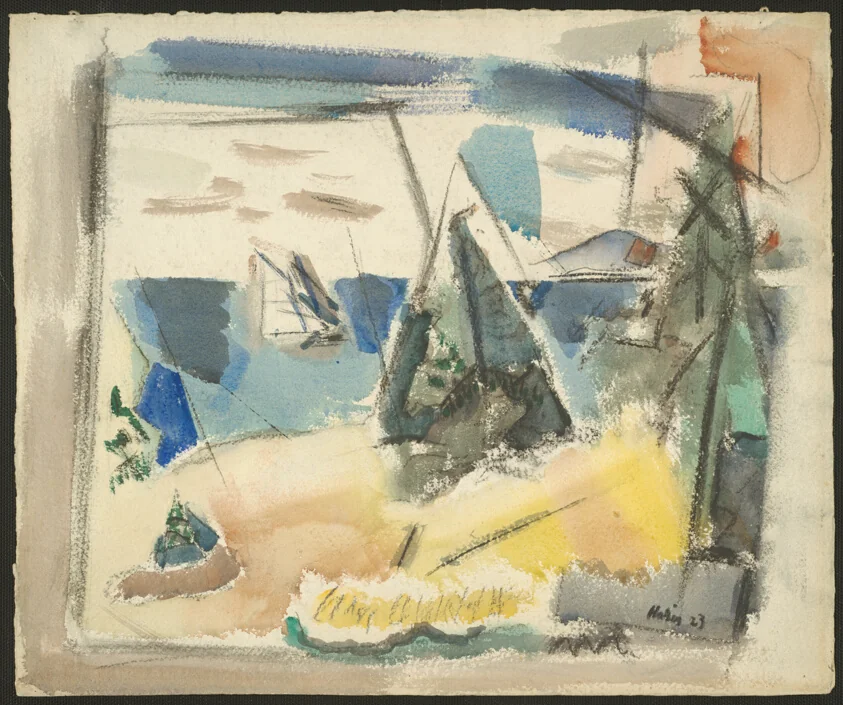
This is a view from an island on the western side of Jerico Bay, which served as a reference point for sailors headed west into Stonington, Maine. Strong triangles formed by two pine trees are echoed by the white sail of a fishing vessel. From the pooling of his washes, it seems Marin worked upright. Playing with his paint, he let the urge to manipulate it drive the marks he made. He reinforced his watercolor lines with fabricated chalk, establishing them as symbols of the forces that connect the big elements of nature. He contrasted the deep black charcoal lines with broad, pale, transparent watercolor brushstrokes, creating a sense of energy. The painted internal frame keeps warring elements in check and signals the artist’s filtering of objective reality through his own experience.

From Bold Island, Maine

John Marin

1923

Accession Number

180823

Medium

Watercolor with blotting, fabricated charcoal, and charcoal wash, on moderately thick, moderately textured, ivory wove paper

Dimensions

43.2 × 51.5 cm (17 1/16 × 20 5/16 in.)

Classification

drawings (visual works)

Museum

The Art Institute of Chicago

Chicago, United States

Credit Line

Gift of Leo S. Guthman

Background & Context

Background Story

"From Bold Island, Maine" is a 1923 watercolor that captures John Marin at his most intimate and atmospheric, returning to the coastal landscapes that had sustained his earliest work after the explosive urban watercolors of the early 1920s. The composition shows a view of the Maine coast from Bold Island, the rocky shore and turbulent water rendered with the blotting, fabricated charcoal, and charcoal wash techniques that Marin had perfected to suggest the humid, wind-blown atmosphere of the Atlantic northeast. The palette is cool and muted—pale blues, greys, and the warm browns of weathered rock—creating an atmosphere of quiet contemplation rather than the chromatic violence of his bridge paintings. This return to Maine was both personal and artistic: Marin had been summering in the state since 1914, and the coastal landscape provided a counterbalance to the urban energy of his New York work, a space of natural rhythm that informed his abstract vocabulary even when the subject was not explicitly rural. The technique of blotting—pressing a second sheet against the wet painting to create mirrored effects—creates accidental textures that suggest the randomness of nature, the way waves and wind shape the shore without human intention. Art historians have connected this watercolor to the broader tradition of American coastal painting, from the luminist works of Fitz Henry Lane to the more expressive seascapes of Winslow Homer, noting that Marin's treatment is more abstract, less topographically specific than these predecessors. The work also demonstrates Marin's mastery of the watercolor medium at its most expansive: the sheet is large enough to create an immersive experience, drawing the viewer into the coastal atmosphere rather than presenting the landscape as a distant view.

Cultural Impact

This 1923 Maine watercolor returned to coastal intimacy after urban explosion, using blotting accidents and charcoal wash to make Atlantic atmosphere immersive while bridging American luminism with modernist abstraction.

Why It Matters

It matters because Marin looked at a Maine island and made the paper breathe salt—proving that even quiet coastlines could carry the same energy as cities if the water was wild enough.