Provenance
Estate of the artist [Lugt Suppl. 388a]; by descent to her daughter, Mme. Ernst Rouart (née Julie Manet; d. 1966), to around 1930 [according to Angoulvent 1933]. De Hauke and Company, New York, by 1930 [the registrar’s card states that de Hauke lent the drawing to the 1930 exhibition at the Art Institute]. Sold by Jacques Seligmannn & Co., New York, to the Art Institute, 1933.
Accession Number
13916
Medium
Watercolor, with touches of gouache, over graphite, on off-white wove paper
Dimensions
20.6 × 17.3 cm (8 1/8 × 6 13/16 in.)
Classification
watercolor
Credit Line
Gift of Mrs. Charles Netcher in memory of Charles Netcher II
Background & Context
Background Story
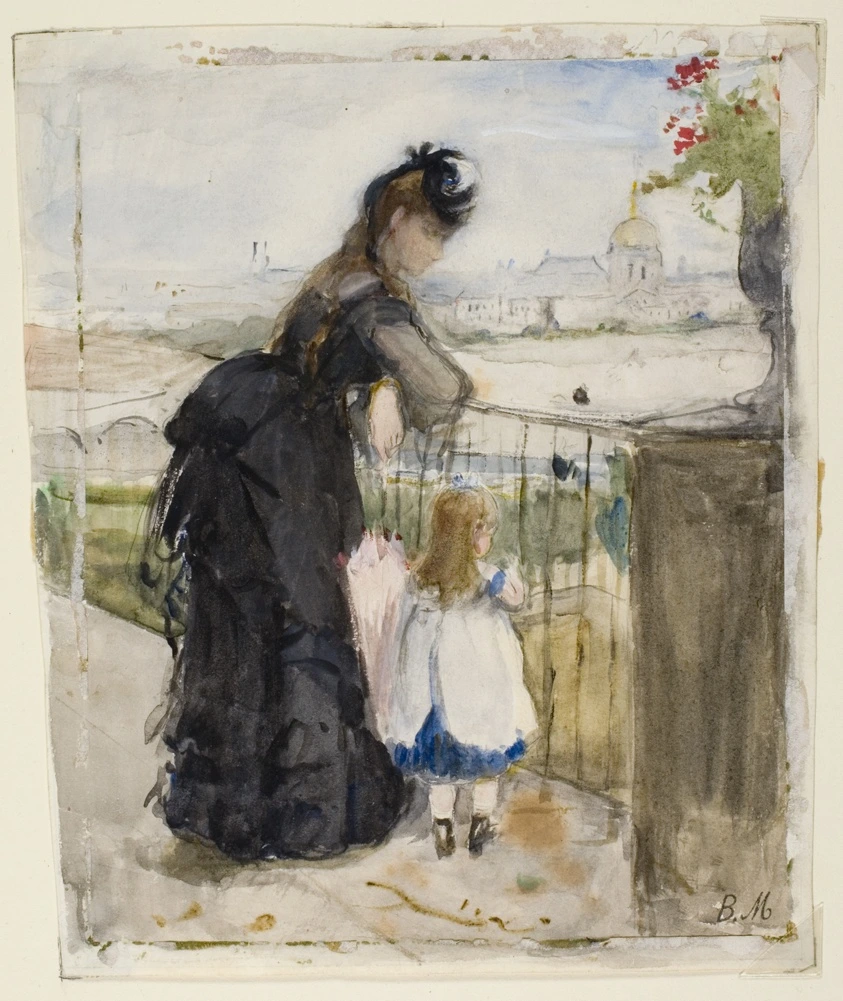
"On the Balcony" is one of Berthe Morisot's most charming and characteristic watercolors, executed in 1871–72 during the period when she was establishing herself as a core member of the Impressionist circle and developing the intimate, domestic subjects that would define her contribution to the movement. The composition shows a figure—probably a woman or child—on a balcony overlooking a garden or street, the scene rendered in watercolor with touches of gouache over graphite on off-white wove paper with a delicacy that makes the modest sheet feel precious. The balcony motif is significant in Morisot's work: it represents the threshold between interior and exterior, the private domestic space and the public urban world, and her treatment of this liminal zone captures the particular quality of light and air that pervades French apartment life. The technique is extraordinarily fluid: transparent washes suggest the sky and foliage beyond the balcony rail, while the gouache highlights pick out the figure's clothing and the architectural details of the balustrade. The palette is high-keyed and sunlit—pale blues, greens, and creams that create an atmosphere of bourgeois leisure and quiet observation. The 1871–72 date places this work in the aftermath of the Franco-Prussian War and the Paris Commune, suggesting that Morisot's domestic subjects may carry a subtle political weight: the peaceful balcony scene asserts the possibility of normal life after catastrophe. Art historians have compared this watercolor to the balcony paintings of Manet, particularly "The Balcony" of 1868, noting that Morisot's treatment is more informal, more focused on the private experience of the space than the social observation of her brother-in-law. The work also demonstrates Morisot's mastery of watercolor as an independent medium: the image requires no translation into oil to achieve its full effect, the transparency of the watercolor itself conveying the luminosity of the observed scene.
Cultural Impact
This 1871–72 watercolor captured post-war domestic threshold luminosity, using transparent balcony washes and gouache highlights to assert normal life after Franco-Prussian catastrophe through bourgeois leisure intimacy.
Why It Matters
It matters because Morisot painted a balcony and made it feel like peace—proving that even a railing could hold a whole world of quiet if the light was gentle enough.