Study for a Composition

Description

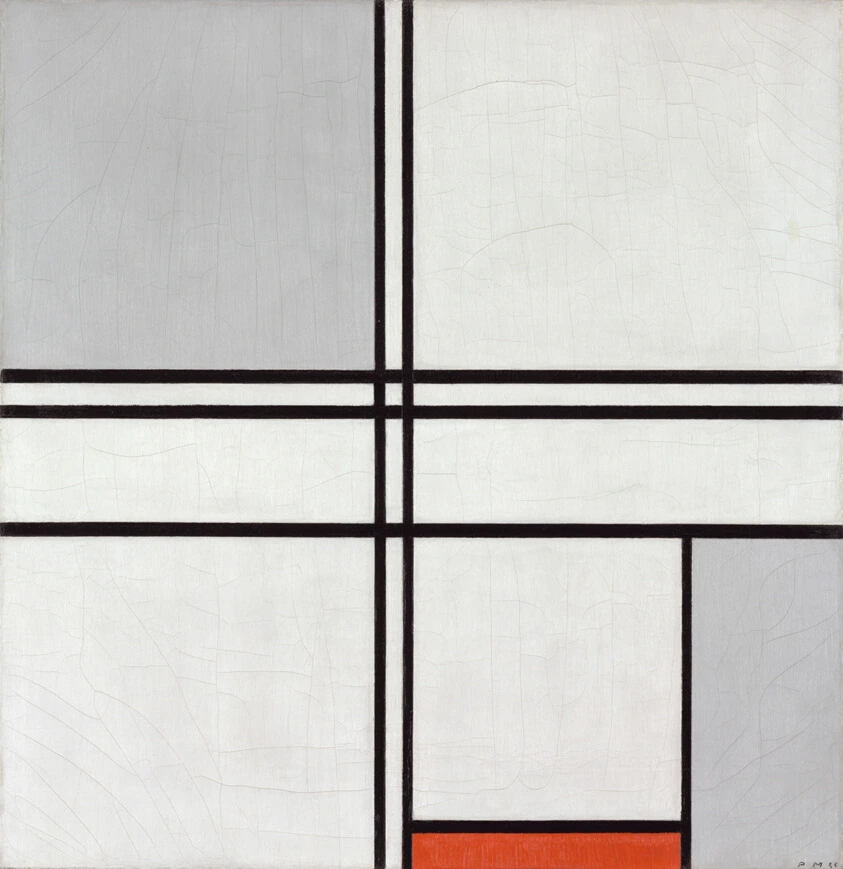
In 1916, after a long search for an entirely new visual vocabulary to represent the physical world, Piet Mondrian arrived at a fully abstract style. He reduced bridges, churches, rivers, trees, and more to a series of horizontal and vertical black lines enclosing fields of unmixed red, blue, and yellow as well as white, black, and gray. This artistic idiom, eventually called Neoplasticism, removed naturalism from painting to reveal the essence of visual forms and provide viewers with a transcendental experience.

While Mondrian’s abstractions may seem simple, he worked hard to achieve the dynamic yet harmonious balance between line and color. He labored over the location, spacing, and thickness of every line, making numerous charcoal sketches both on paper and directly on the canvas. Although not immediately related to any finished painting, Study for a Composition shows the artist’s obsession with the density and placement of line and the number, size, and location of color fields. Here, he collaged red and blue papers to the sheet to examine their weight and position in relation to other elements. This work is the only known surviving study by Mondrian with colored collage elements.

Provenance

Bequeathed by the artist to his friend, Harry Holtzman (1912-1987), New York; Harry Holtzman, to 1964 [according to Joosten 1998]. Marlborough-Gerson Gallery, New York, by April 1964 [New York 1964 exh. cat.]; sold by Marlborough-Gerson Gallery to Dorothy Braude Edinburg, Brookline, Mass., May 29, 1969; given to the Art Institute of Chicago, 2013.

Study for a Composition

Piet Mondrian

1940–41

Accession Number

142570

Medium

Collage of cut and pasted papers, prepared with gouache and charcoal, on pieced cream wove newsprint in three parts with charcoal on verso

Dimensions

Max: 33 × 27 cm (13 × 10 11/16 in.)

Classification

collage

Museum

The Art Institute of Chicago

Chicago, United States

Credit Line

Gift of Dorothy Braude Edinburg to the Harry B. and Bessie K. Braude Memorial Collection
Background & Context

Background Story

"Study for a Composition" is a 1940–41 collage by Piet Mondrian that documents the Dutch master's working process during his final years in New York, the image showing the cut-and-pasted papers, gouache, and charcoal that Mondrian used to plan his last paintings, including the famous "Broadway Boogie Woogie." The composition is a small, intimate arrangement of paper fragments in a grid-like pattern, the rough, provisional quality of the collage contrasting with the polished perfection of the finished paintings, the study revealing the experimentation and uncertainty that underlay the apparent inevitability of Mondrian's mature style. The cream wove newsprint provides a warm, everyday ground that makes the abstract composition feel approachable and human, the pieced paper suggesting both the construction process and the urban environment—newspapers, advertisements, street signs—that inspired Mondrian's American period. The 1940–41 date places this work in the period of Mondrian's emigration to New York and his exposure to the energy of American urban life, the collages serving as a laboratory for the rhythmic, syncopated compositions that would characterize his final masterpieces. Art historians have connected this collage to the broader tradition of the artist's sketch and study, from the Renaissance preparatory drawings to the modernist collage experiments of Picasso and Braque, noting that Mondrian's treatment is more systematic, more focused on the structural possibilities of the grid than the improvisational freedom of these predecessors. The work also demonstrates Mondrian's mastery of collage as an independent medium: the fragments of paper achieve a completeness and visual interest that requires no translation into paint to achieve their full effect.

Cultural Impact

This 1940–41 collage revealed late New York working-process experimentation through pieced newsprint grid roughness, using cream-paper approachability to make Broadway-Boogie-Woogie planning feel structurally systematic yet humanly provisional.

Why It Matters

It matters because Mondrian glued scraps of paper together and made them look like a city—proving that even a study could hold a whole world if the grid was right.