Approaching Fog

Description

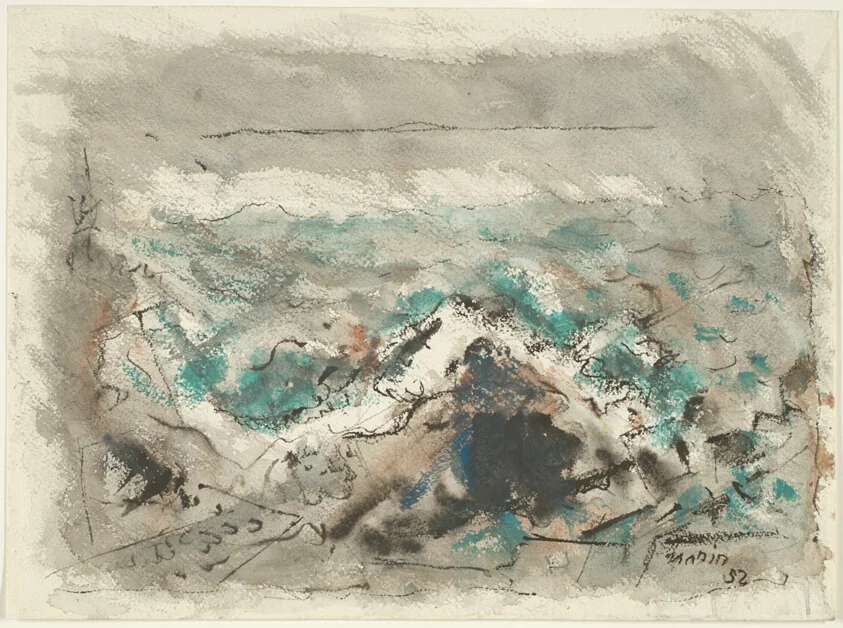
This late watercolor looks outward from Marin’s home toward the tide marker rock, coastal ledges, and waters of Pleasant Bay. A somber portrait of the sea by one who understood its character intimately, the work alludes to a gradual envelopment by nothingness, aging, and death. Yet it possesses energy and excitement: splashes of green and red shimmer though the gray mists, while calligraphic black lines activate the surf and air. These marks, some applied with a medical syringe, reflect the artist’s awareness of recent developments in Action Painting. Here he blotted, scraped, and wiped pigment, combining transparent and opaque watercolor, brush and black ink, and fabricated charcoal.

Approaching Fog

John Marin

1952

Accession Number

199870

Medium

Watercolor with blotting, wiping and traces of scraping, and with brush and black ink, graphite, fabricated charcoal, and touches of opaque watercolor on medium-weight, rough-textured, off-white wove paper (four edges trimmed)

Dimensions

37.5 × 50.8 cm (14 13/16 × 20 in.)

Classification

paper

Museum

The Art Institute of Chicago

Chicago, United States

Credit Line

Suzanne Searle Dixon Endowment, Olivia Shaler Swan Memorial Fund, William H. Tuthill Fund

Background & Context

Background Story

"Approaching Fog" is one of John Marin's most atmospheric late watercolors, executed in 1952 during the final decade of a career that had spanned six decades and had seen American art transform from tonalism to Abstract Expressionism. The composition shows a coastal or rural landscape dissolving into fog, the forms of trees, water, and shore reduced to pale tonal gradations that suggest rather than describe, creating an image that hovers on the edge of pure abstraction. The technique is extraordinarily complex for so ethereal a subject: watercolor with blotting, wiping, traces of scraping, brush and black ink, graphite, fabricated charcoal, and touches of opaque watercolor on medium-weight rough-textured off-white wove paper. This accumulation of media creates a surface that is rich and varied despite the image's apparent simplicity, the different materials interacting to produce effects that no single medium could achieve. The 1952 date places this work in the period when Marin was in his seventies and had largely retreated from the New York art world to his home in Maine, producing watercolors that reflected his physical distance from the urban centers of artistic fashion. The fog motif itself is significant: it represents both a natural phenomenon and a metaphor for the uncertainty of age, the way vision clouds and forms dissolve as time passes. Art historians have connected this work to the broader tradition of American Tonalism, particularly the misty landscapes of Whistler and Inness, noting that Marin's treatment is more abstract, more physically energetic than these predecessors. The painting also demonstrates Marin's lifelong commitment to watercolor as a medium for serious artistic expression: even in his final years, he was pushing the possibilities of the medium with an ambition that belied its reputation as a mere sketching tool.

Cultural Impact

This 1952 late watercolor dissolved coastal landscape into multi-media fog abstraction, using accumulated material complexity to bridge Tonalist mist metaphor with Abstract Expressionist physical energy in final-decade Maine retreat.

Why It Matters

It matters because Marin painted fog at seventy and made it look like he was still finding new things to see—proving that even blindness could be a subject if the paper was willing.