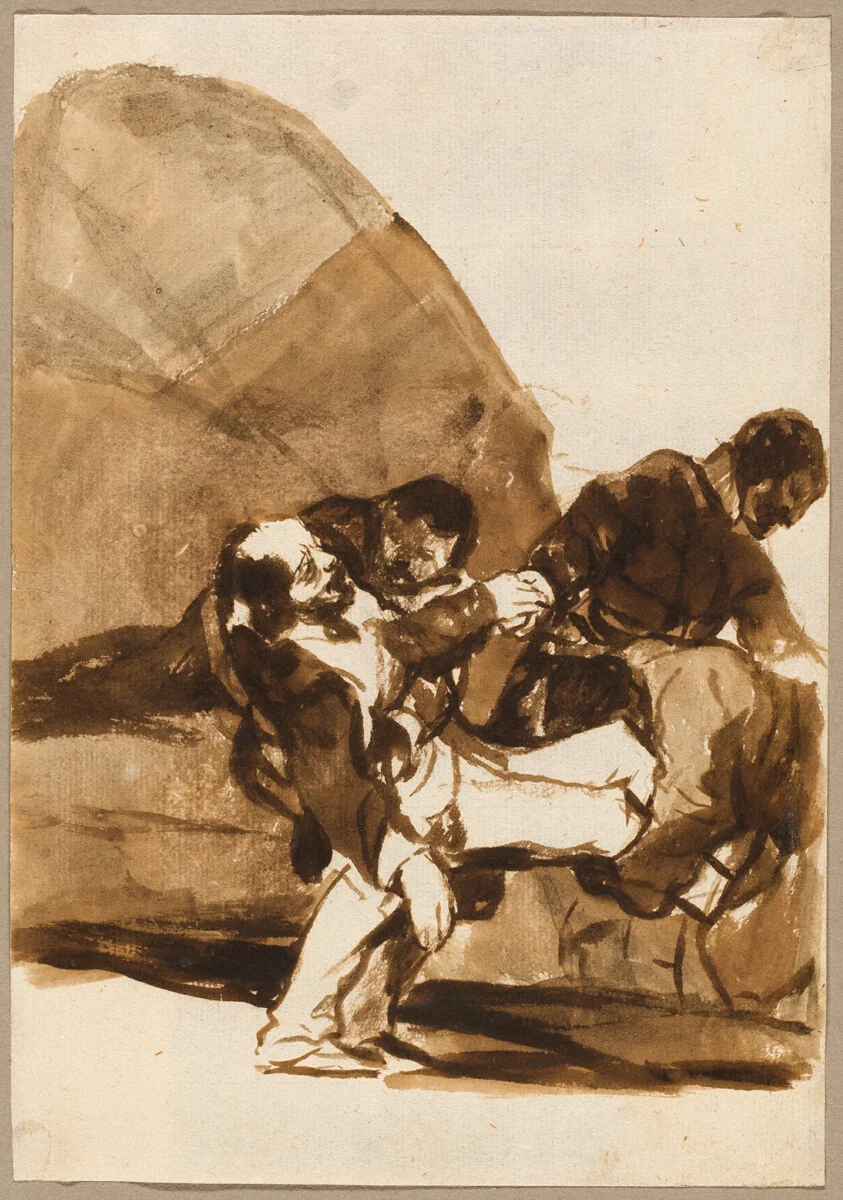
Three Men Carrying a Wounded Soldier, from the Images of Spain, Album F

Description

Goya’s bold watercolor is very far from the emphasis on pure line of the restrained Classicism that characterizes many of the works from this period. Goya applied his washes with an abandon that verged on the abstract. Indeed, it can be difficult to separate the knot of individual figures, three of them carrying a fourth, in a scene that recalls images of the Deposition of Christ. Probably produced during the Spanish War of Independence against Napoleonic France (1808–14), Goya’s drawing unflinchingly treats the senseless violence and social chaos that defined the period.

Provenance

Probably by descent to the artist's son, Javier Goya, Madrid [according to Sayre 1958]. Mariano Goya, Madrid [according to Joachim 1979]. Valentin Carderera, Madrid (?)[according to Joachim 1979]. Paul Lebas, Paris [according to Gassier 1973]. Sold, Hôtel Drouot, Paris, April 3, 1877, lot 32, to Emile Calando [according to a letter from Pierre Gassier dated October 16, 1981 in curatorial file]; sold, Hôtel Drouot, Paris, December 11-12, 1899, lot 69. Paul Meurice (died 1906), Paris [according to Gassier 1973]; sold, Hôtel Drouot, Paris, May 25, 1906. Sold, Galerie Jean Charpentier, Paris, April 9, 1957, lot 61, to Hans Maximilian Calmann, London [according to annotated sale cat.]; sold to the Art Institute, 1960.

Three Men Carrying a Wounded Soldier, from the Images of Spain, Album F

Francisco José de Goya y Lucientes

1812/20

Accession Number

12030

Medium

Brush with brown ink and brown and gray wash over traces of black chalk, on cream laid paper

Dimensions

20.2 × 14.1 cm (8 × 5 9/16 in.)

Classification

pen and ink drawings

Museum

The Art Institute of Chicago

Chicago, United States

Credit Line

Clarence Buckingham Collection

Background & Context

Background Story

Francisco Goya's "Three Men Carrying a Wounded Soldier" (1812/20) is a brush and brown ink drawing with brown and gray wash over traces of black chalk on cream laid paper, from the series known as the "Images of Spain" (Album F). The Images of Spain albums, produced between 1812 and 1823, record Goya's observations of Spanish life during and after the Napoleonic Wars. This drawing shows three men carrying a wounded soldier, the body of the wounded man supported by his comrades. The subject is one of war and its human cost, a theme that dominated Goya's work during this period. The brush and ink technique is rapid and expressive, the forms suggested with broad washes of brown and gray. The dark wash around the figures creates a sense of oppressive atmosphere. The cream laid paper provides a warm ground. This drawing belongs to the series of works that would culminate in Goya's great print series "The Disasters of War," one of the most powerful anti-war statements in the history of art.

Cultural Impact

Goya's Images of Spain albums document the impact of the Napoleonic Wars on Spanish society, recording scenes of suffering and survival with an immediacy that continues to move viewers more than two centuries later.

Why It Matters

This drawing of a wounded soldier being carried by his comrades captures the human cost of war with devastating economy, the dark wash and expressive line conveying the weight of the wounded body and the burden of care.