Description
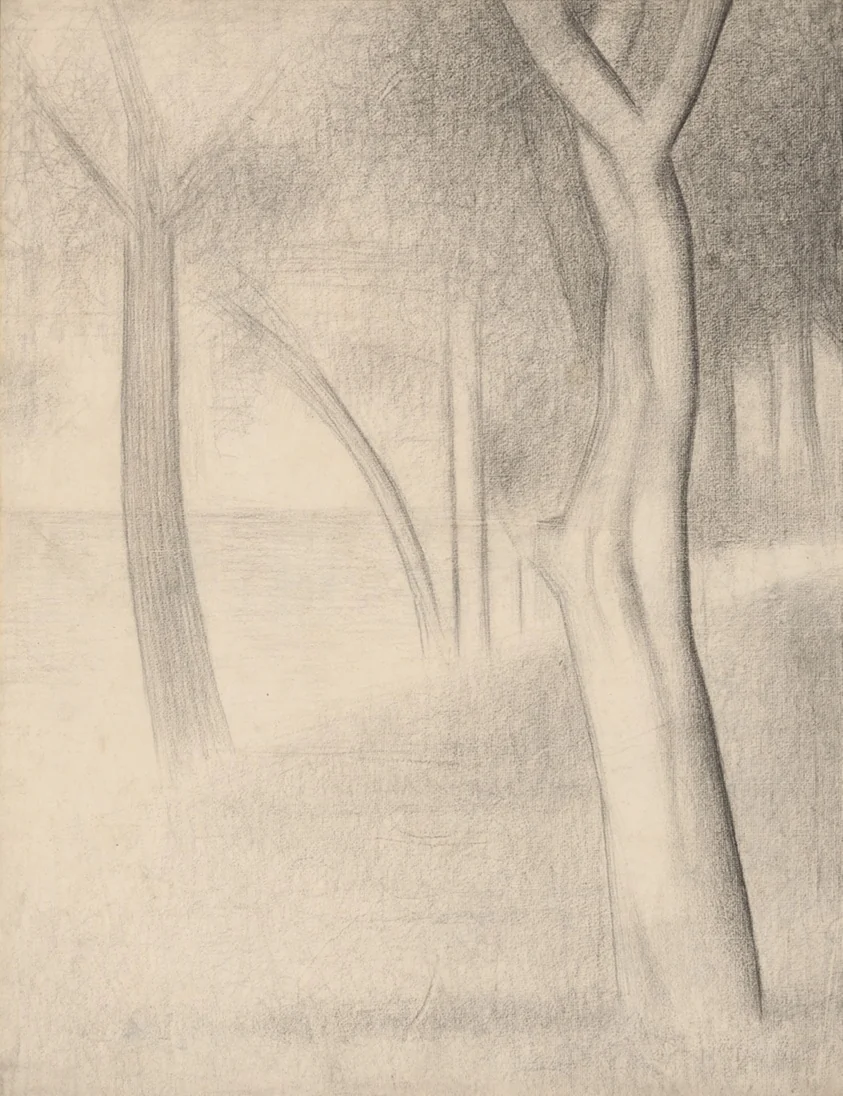
Trees is one of 40 studies Georges Seurat did for his masterpiece, A Sunday on La Grande Jatte, 1884. With these studies, the artist refined the individual elements of his composition so that together they would form a harmonious whole. Here he focused on the trees near the riverbank, using the rich tones of the conté crayon and the grainy paper surface to approximate the appearance of his paintings. In the final painting, Seurat combined the tree in the foreground and the one leaning out over the river in order to orient the composition toward the water.
Provenance
Seurat family [invoice]; by descent to Mme Léopold Appert (1881-1969), Paris [according to New York 1991]; Private Collection, Paris, by 1958-1966 [Chicago 1958; according to New York 1991]; sold to Wildenstein and Company New York, March 1966 [according to New York 1991]; sold to the Art Institute, 1966.
Accession Number
154022
Medium
Black Conté crayon, on white laid paper, laid down on cream board
Dimensions
62 × 47.5 cm (24 7/16 × 18 3/4 in.)
Classification
conté crayon
Credit Line
Helen Regenstein Collection
Tags
Color: White
Background & Context
Background Story
"Trees (study for La Grande Jatte)" is an 1884 black Conté crayon drawing by Georges Seurat that captures the French Neo-Impressionist master in one of his most serene and structurally resolved preparatory studies, the image showing trees rendered with the bold, simplified forms and the tonal precision that would inform the background of the finished painting. The composition is a large drawing—62 × 47.5 centimeters—showing trees in the park setting with the same attention to the underlying geometric structure and the atmospheric effects that characterized Seurat's entire approach to drawing. The Conté crayon on white laid paper, laid down on cream board, creates a surface of extraordinary clarity and permanence, the drawing suggesting both the immediacy of the outdoor observation and the deliberation of the studio preparation. The 1884 date places this work in the earliest period of the "La Grande Jatte" project, when Seurat was producing the landscape studies that would establish the compositional framework for the finished painting. Art historians have connected this study to the broader tradition of the landscape study in modern art, from the drawings of Corot to the plein-air sketches of the Impressionists, noting that Seurat's treatment is more focused on the formal structure and the tonal organization, the systematic reduction of nature to geometric forms and tonal patterns, than the atmospheric effect or the coloristic variation of these other traditions.
Cultural Impact
This 1884 Conté crayon study made La Grande Jatte trees structurally serene through large 62cm bold simplified geometric forms and white-laid cream-board permanent clarity, using earliest project-period deliberation to systematically reduce nature into tonal pattern beyond Corot atmospheric landscape tradition.
Why It Matters
It matters because Seurat drew trees for his greatest painting and made the paper feel like it was growing in perfect geometry—proving that even a park could be a cathedral if the lines were straight enough.


