Provenance
Mme Ernest Rouart (née Julie Manet, the artist’s daughter, died 1966), Paris. E. and A. Silberman Galleries, Inc., New York; sold Sotheby’s Parke & Bernet, New York, April 17, 1969, lot 125 (ill.) to Estelle P. McCormick, Philadelphia; bequeathed to the Art Institute, 1978.
Accession Number
53058
Medium
Oil on canvas
Dimensions
54.2 × 64.8 cm (21 3/8 × 25 1/2 in.)
Classification
oil on canvas
Credit Line
Bequest of Estelle McCormick
Background & Context
Background Story
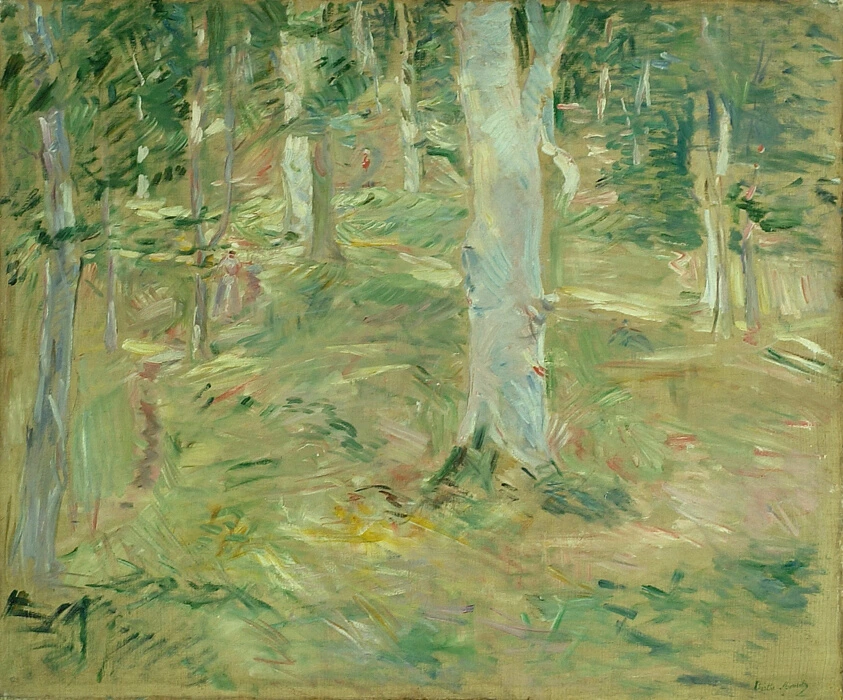
Berthe Morisot's "Forêt de Compiègne" (1885) is an oil on canvas that captures the dappled light and atmospheric depth of the great forest north of Paris. The Forêt de Compiègne was a popular destination for Parisians seeking relief from the city, and its ancient oaks and beeches had attracted artists for centuries. Morisot's treatment is characteristically Impressionist: rather than describing individual trees with botanical precision, she captures the overall sensation of being in the forest—the pattern of light filtering through the canopy, the cool green shadows, the sense of enclosed, intimate space. Her brushwork is rapid and feathery, the paint applied in small strokes that seem to flicker across the canvas. The palette is dominated by greens, varied from yellow-green in the sunlit areas to deep, cool greens in the shadows. This painting dates from the period of Morisot's fullest maturity as an Impressionist, when her technique had achieved its maximum freedom and expressiveness.
Cultural Impact
Morisot's forest scenes demonstrate her remarkable ability to capture the complex effects of light filtering through foliage, a subject that challenged even the most accomplished Impressionists.
Why It Matters
This painting of the forest at Compiègne captures the essence of Morisot's Impressionism: the light, the atmosphere, the sense of being enveloped by nature, rendered with brushwork that seems as alive as the leaves themselves.