Accession Number
182805
Medium
Etching and engraving, with watercolor, on ivory Japanese paper
Dimensions
Plate: 31.8 × 24 cm (12 9/16 × 9 1/2 in.); Sheet: 36 × 25.5 cm (14 3/16 × 10 1/16 in.)
Classification
etching
Credit Line
Bequest of Paul Gerstley
Background & Context
Background Story
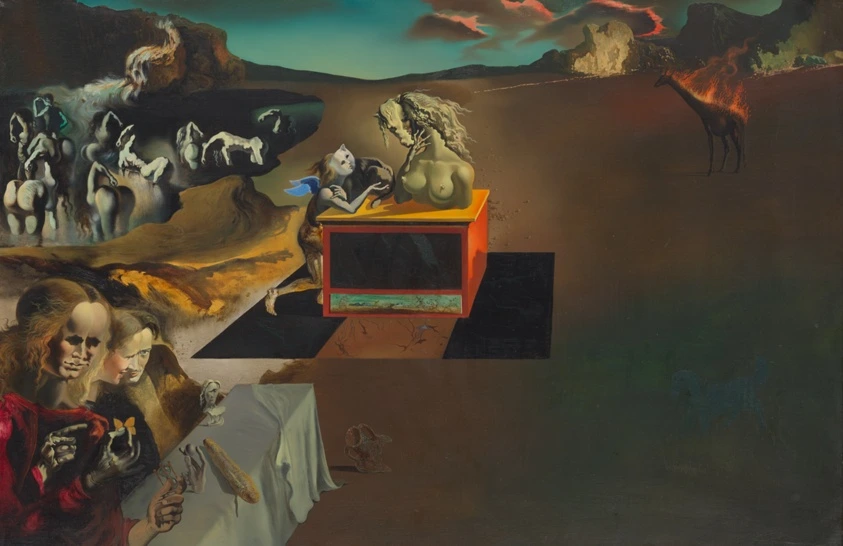
"The Drawers" is a 1967 etching and engraving with watercolor on ivory Japanese paper by Salvador Dalí that captures the Spanish Surrealist in his most provocatively suggestive and technically refined printmaking mode, the image showing one of his most famous and repeated motifs rendered with the same hallucinatory precision and sexual symbolism that characterized his entire mature oeuvre. The composition is a medium-sized print—plate 31.8 × 24 centimeters, sheet 36 × 25.5 centimeters—showing drawers emerging from the body with the etching and engraving creating a surface of extraordinary precision and disturbing suggestion. The watercolor additions add a dimension of painterly warmth and chromatic variation that enhances the hallucinatory quality of the image. The 1967 date places this work in the period of Dalí's continued production of prints based on his earlier Surrealist themes and his commercial exploitation of his own iconic imagery. Art historians have connected this print to the broader tradition of the body as container in Surrealist art, from the paintings of de Chirico to the sculptures of Oppenheim, noting that Dalí's treatment is more focused on the sexual suggestion and the hallucinatory precision, the transformation of psychological symbol into commercial icon, than the philosophical depth or the critical edge of these other traditions.
Cultural Impact
This 1967 etching engraving watercolor made drawers provocatively hallucinatory through medium 31cm precise disturbing sexual suggestion and ivory-Japanese-paper painterly warmth, using mature commercial exploitation to transform body-container Surrealist symbol into commercial icon beyond de Chirico philosophical critical depth.
Why It Matters
It matters because Dalí etched drawers on a body and made the paper feel like it was opening secrets nobody asked for—proving that even a drawer could be a Freudian trap if the etching was precise enough.