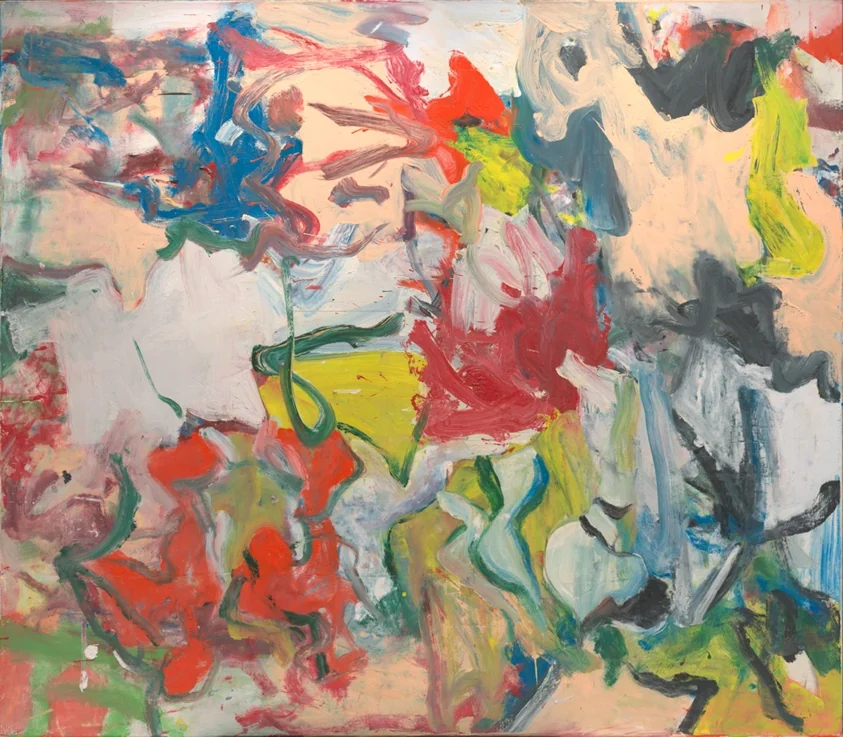
Untitled XI

Description

Willem de Kooning is known for emotive, gestural canvases that transcend conventional definitions of figuration and abstraction. In the late 1960s and early 1970s, he turned his attention away from painting, instead focusing on sculpture, printmaking, and drawing. In 1975, at the age of 71, de Kooning began one of the most productive periods of painting in his career, quickly completing 20 new, large canvases within 6 months. Untitled XI belongs to this series, which was, with a few exceptions, untitled and chronologically numbered. Moving away from tightly organized compositions, de Kooning used free-flowing brushwork and softened, sensuous hues to liberate form. Here the figurative references that are dominant in his earlier work are nearly lost within a far more lyrical and joyful abstract landscape.

Provenance

The artist, New York, from 1975. Sold, Xavier Fourcade, New York, to Richard C. Hedreen, Seattle, by 1979. Sold, Xavier Fourcade to the Art Institute, 1983.

Untitled XI

Willem de Kooning

1975

Accession Number

100830

Medium

Oil on linen

Dimensions

Without frame: 195.6 × 223.5 cm (77 1/16 × 88 in.); 195.6 × 223.6 cm (77 × 88 in.)

Classification

Painting

Museum

The Art Institute of Chicago

Chicago, United States

Credit Line

Through prior bequests of John J. Ireland and Joseph Winterbotham; Walter Aitken Endowment

Background & Context

Background Story

"Untitled XI" is a 1975 oil on linen by Willem de Kooning that captures the Dutch-American Abstract Expressionist in his most abstractly fluid and luminously atmospheric late mode, the image showing an abstract composition rendered with the same sweeping gestures and coloristic richness that characterized his entire career, but with a new sense of openness and lyrical freedom. The composition is a very large canvas—195.6 × 223.5 centimeters—showing an abstract composition with the oil on linen creating a surface of extraordinary scale and atmospheric depth. The linen support provides a smooth, responsive ground that enhances the fluidity and luminosity of the brushwork. The 1975 date places this work in the period of de Kooning's late abstraction, when he moved away from the figure entirely and produced the works that demonstrated his mastery of pure gesture and color. Art historians have connected this painting to the broader tradition of late abstraction in American art, from the drip paintings of Pollock to the color fields of Rothko, noting that de Kooning's treatment is more focused on the gestural fluidity and the lyrical openness, the transformation of abstract form into emotional release, than the compositional structure or the formal purity of these other traditions.

Cultural Impact

This 1975 oil linen made late abstraction fluidly luminous through very large 195cm sweeping gestural openness and smooth linen-support atmospheric lyrical freedom, using post-figure period to transform pure gesture color into emotional release beyond Pollock compositional formal structure.

Why It Matters

It matters because de Kooning painted without figures and made the canvas feel like it was floating in pure color and movement—proving that even emptiness could be full if the gesture was free enough.