Accession Number
64379
Medium
Pen and ink on paper
Dimensions
24.8 × 27.8 cm (9 13/16 × 11 in.)
Classification
pen and ink drawings
Credit Line
Gift of David Adler
Background & Context
Background Story
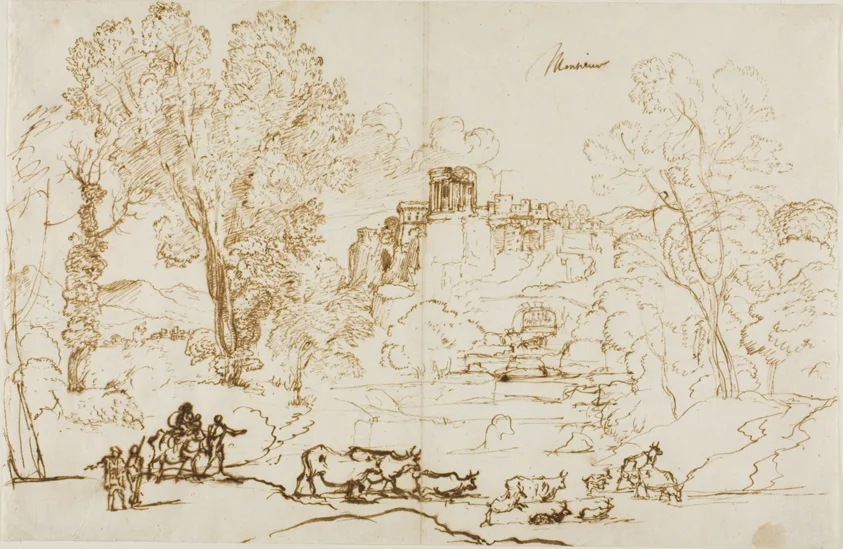
Claude Lorrain's "Classical Landscape - Tivoli" (1636) is a pen and ink drawing on paper depicting the picturesque town of Tivoli near Rome, with its famous waterfalls and the Temple of Vesta. Claude Gellée, known as Claude Lorrain (c. 1600–1682), was the greatest landscape painter of the 17th century. Tivoli was a popular destination for artists in Rome, offering dramatic natural scenery combined with ancient Roman ruins. This drawing shows Claude working directly from nature, recording the specific topography of Tivoli with the freshness of direct observation. The pen and ink technique is precise yet spontaneous, the lines delineating the forms of the landscape with the clarity that characterizes all of Claude's work. Unlike many of his contemporaries who treated landscape as a backdrop for historical or religious subjects, Claude made the landscape itself the primary subject, infusing it with a golden, poetic atmosphere that seemed to capture the essence of the Roman Campagna. This early drawing shows the young artist developing the vision that would transform European landscape painting.
Cultural Impact
Claude Lorrain's landscape drawings established a new standard for the poetic representation of nature, influencing generations of landscape painters from Turner to Corot to the Impressionists.
Why It Matters
This drawing of Tivoli captures Claude in the act of direct observation, the pen and ink technique recording the specific character of a place that would become one of the most painted sites in the history of art.


