Provenance
Sir Thomas Lawrence (died 1830), London [Lugt 2445]. William Esdaile (died 1837), London [Lugt 2617]. William Benoni White (died around 1878), London [Lugt 2592]. C. Fairfax Murray, London; sold, Christie's, London, January 30, 1920, lot 171. Tancred Borenius (died 1948), London [according to New York 1959]. Sold by Erwin Rosenthal, Berkeley, Calif., to the Art Institute, 1956.
Accession Number
4949
Medium
Black chalk, white and gray gouache, on tan laid paper, laid down on perimeter to cream wove card
Dimensions
39.3 × 23.2 cm (15 1/2 × 9 3/16 in.)
Classification
gouache
Credit Line
Frances A. Elkins Fund
Background & Context
Background Story
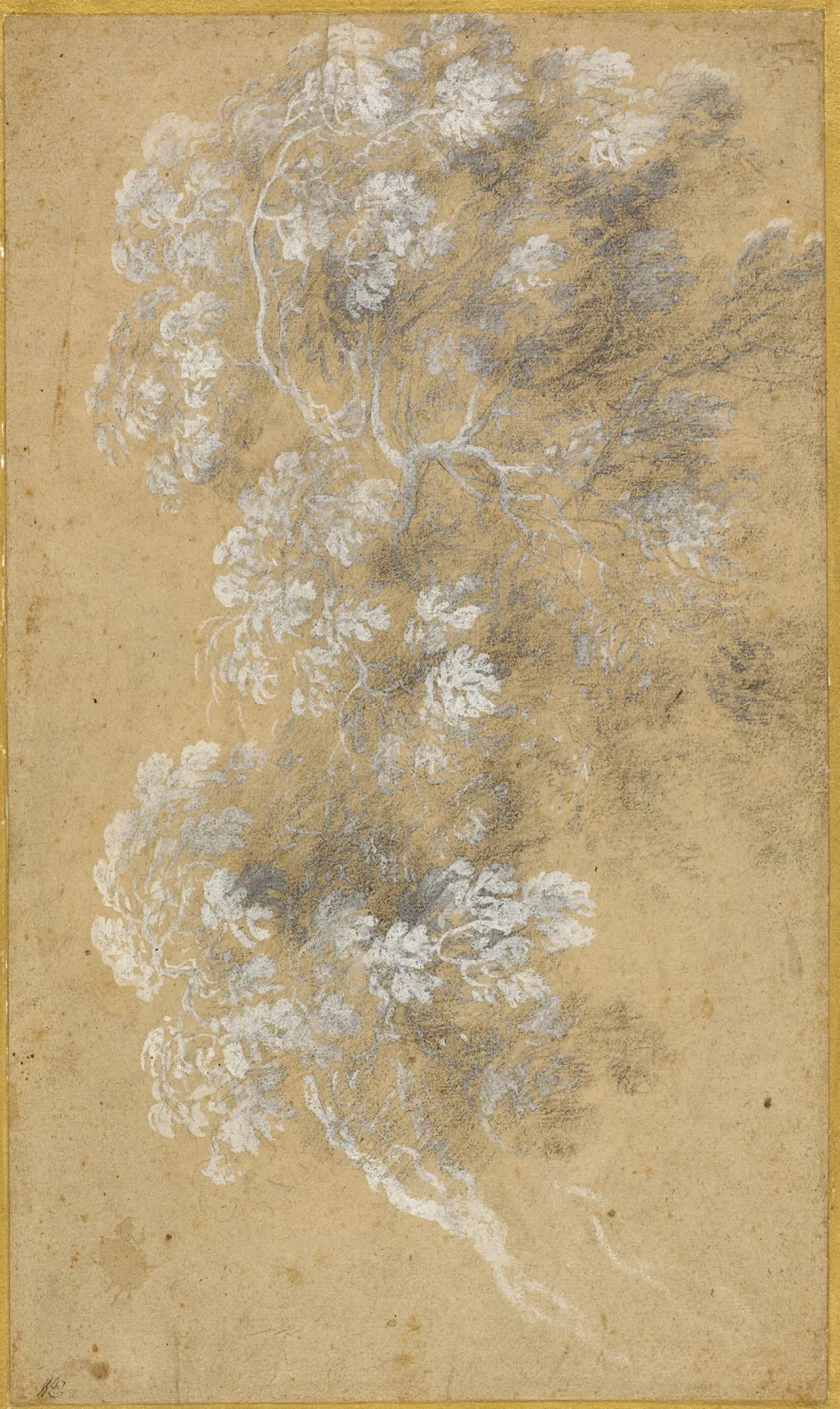
Claude Lorrain's "Sketch of Foliage and Branches" (c. 1645–50) is a study in black chalk with white and gray gouache on tan laid paper. This drawing is a focused study of a specific natural element—the leaves and branches of a tree—executed with extraordinary sensitivity to form and texture. Unlike Claude's more finished landscape compositions, this is a working study, a piece of direct observation from nature. The black chalk defines the structure of the branches and the masses of leaves, while the white and gray gouache adds highlights and depth. The tan laid paper provides a warm mid-tone. This study reveals the foundation of Claude's art: his careful observation of the natural world. His idealized landscapes were not invented but synthesized from countless such studies, each leaf and branch studied from life before being incorporated into the larger vision. Drawings like this one are essential to understanding how Claude achieved the perfect balance of naturalism and idealization that defines his work.
Cultural Impact
Claude's studies of foliage demonstrate the empirical foundation of his landscape art, showing that his poetic visions were grounded in meticulous observation of nature.
Why It Matters
This study of leaves and branches reveals Claude the naturalist, patiently recording the structure of a tree with the same care he brought to his grandest compositions.


