Description
Claude Lorraine was lured from his northern birthplace, in the French province of Lorraine, to the warmth of Italy, and he made the landscape of Italy his primary focus in paintings, prints, and drawings.
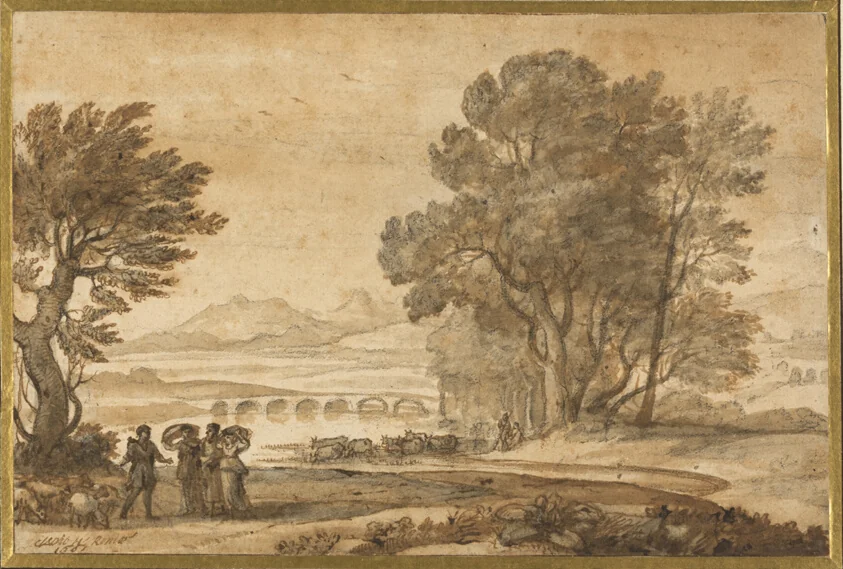
This sun-drenched landscape with a Roman aqueduct in the background is used as a setting for the story from the book of Genesis in which Jacob offers his flocks to Laban in return for the hand of his youngest daughter, Rachel.
Provenance
Given by Colnaghi, London, to Henry George Charles Lascelles (1882–1947), 6th Earl of Harewood, 1922; by descent; sold, Christie's, London, June 25, 1968, lot 74, to Robert M. Light, Boston, for Dorothy Braude Edinburg; given to the Art Institute, 1998.
Accession Number
149029
Medium
Pen and brown ink, with brush and black, brown and gray wash, and black chalk, on cream laid paper, laid down on cream laid card
Dimensions
20.1 × 30.2 cm (7 15/16 × 11 15/16 in.)
Classification
pen and ink drawings
Credit Line
Gift of Dorothy Braude Edinburg to the Harry B. and Bessie K. Braude Memorial Collection
Background & Context
Background Story
Claude Lorrain's "A Wooded River Landscape with Jacob, Laban, and His Daughters" (1661) is a pen and brown ink drawing with brush and black, brown, and gray wash and black chalk on cream laid paper. This drawing belongs to Claude's mature period, when he was at the height of his powers. The biblical subject—Jacob, Laban, and his daughters—provides the narrative frame, but the true subject is the landscape itself: the wooded river scene, the play of light through the trees, the atmospheric distance. Claude's technique in this drawing is extraordinarily refined: the pen and ink provide precise delineation of forms, while the layered washes create the atmospheric depth that was his great gift. The brown and gray washes model the volumes of trees and terrain, creating a sense of space that draws the viewer into the scene. The small figures of Jacob and Laban are almost incidental, their presence serving to anchor the landscape in a biblical past while the real drama is in the light and atmosphere. This drawing is a complete work of art in itself, not merely a preparatory study.
Cultural Impact
Claude's late drawings represent the culmination of his art, achieving a perfect synthesis of natural observation and classical idealization that would define the standard for European landscape painting for two centuries.
Why It Matters
This drawing of a biblical subject is really a landscape of extraordinary atmospheric beauty, the layered washes creating a sense of light and space that transforms a story from Genesis into a vision of earthly paradise.


