Provenance
Galerie Cailleux, Paris [stamp (Cx [in oval]; not in Lugt) recto, lower right, in black]. Sold by Mme. Marcel Guiot, Paris, 1970, to Dorothy Braude Edinburg, Brookline, MA.; given to the Art Institute of Chicago, 2013.
Accession Number
149037
Medium
Black chalk on cream laid paper
Dimensions
24.2 × 37.9 cm (9 9/16 × 14 15/16 in.)
Classification
chalk
Credit Line
Gift of Dorothy Braude Edinburg to the Harry B. and Bessie K. Braude Memorial Collection
Background & Context
Background Story
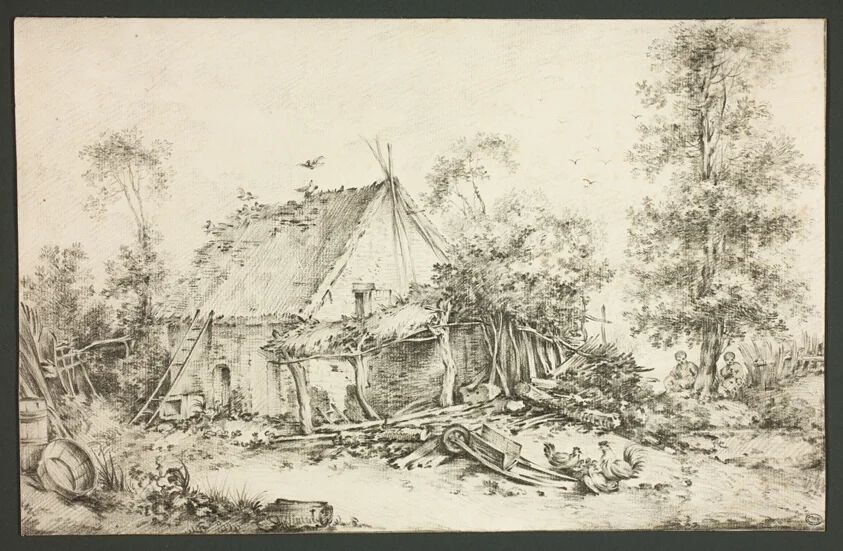
François Boucher's "Farm Courtyard" (c. 1750) is a black chalk drawing on cream laid paper that shows a different side of the artist known primarily for his mythological and pastoral scenes. This drawing of a farm courtyard is a study from life, recording the buildings, animals, and activities of an actual farm with a directness that contrasts with the idealized pastorals of Boucher's finished paintings. The black chalk technique is rapid and economical, the forms suggested with quick strokes that capture the essential character of the scene. The cream laid paper provides a warm, textured ground. Drawings like this one reveal the observational foundation of Boucher's art: even his most idealized compositions were grounded in careful study of the real world. The farm courtyard, with its mix of architectural forms, animal life, and human activity, provided rich material for the artist's eye. This drawing may have been used as source material for the rustic settings of Boucher's pastoral paintings.
Cultural Impact
Boucher's drawings from life demonstrate the observational discipline that underlay the Rococo's most decorative achievements, showing that the master of idealization was also a careful student of reality.
Why It Matters
This chalk drawing of a farm courtyard reveals Boucher the observer, his quick strokes capturing the life of a real farm with a directness that grounds his more idealized pastoral works in the reality of rural life.