Description
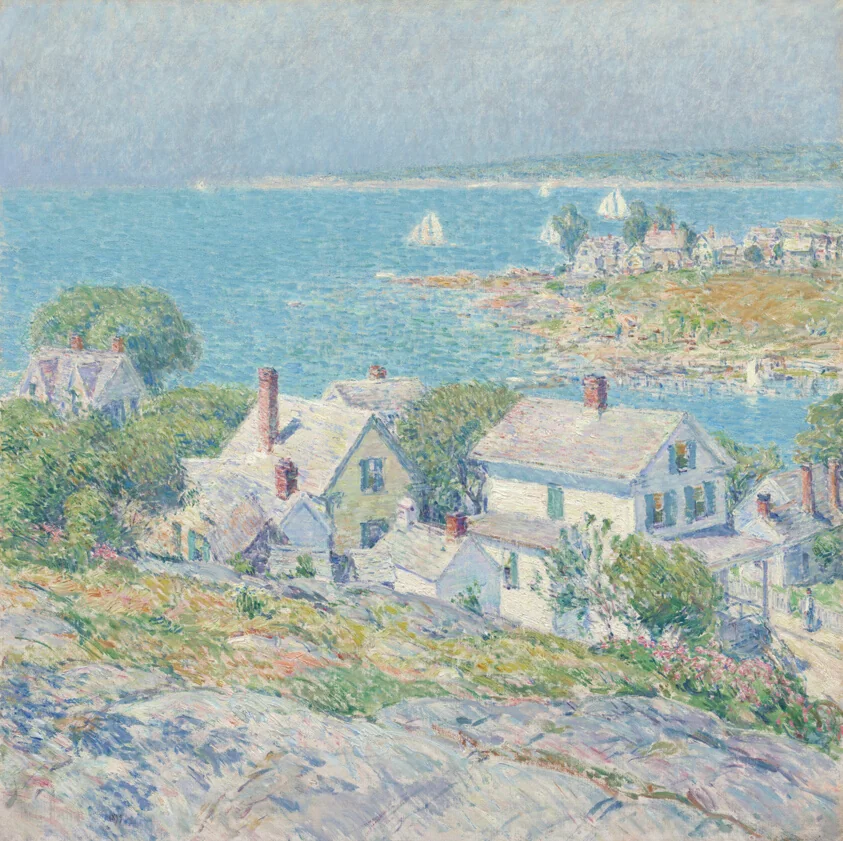
This panoramic landscape depicts one of Childe Hassam’s favorite destinations: Gloucester, Massachusetts. During the summer months Gloucester was home to many artists, who, like Hassam, chose to emphasize its picturesque aspects, such as its quaint buildings and sailing vessels, rather than its fish-processing plants. The composition exhibits Hassam’s broken brushwork and his use of bare canvas, particularly in the foreground. Bright, saturated blues and crisp whites add to the maritime tenor of the work, while the square canvas highlights its architectural quality and harmoniously organized space.
Provenance
Macbeth Galleries, New York City, by 1919; Paul Schulze, Chicago, from 1919 to 1930; given to the Art Institute of Chicago, 1930.
Accession Number
5349
Medium
Oil on canvas
Dimensions
68.9 × 68.9 cm (27 1/8 × 27 1/8 in.)
Classification
Painting
Credit Line
Walter H. Schulze Memorial Collection
Background & Context
Background Story
"New England Headlands" is an 1899 oil on canvas by Childe Hassam that captures the American Impressionist at the height of his powers, the painting demonstrating the synthesis of French color theory and native subject matter that made Hassam the defining painter of American light and landscape at the turn of the twentieth century. The composition shows a coastal scene—probably the rocky shores of Maine or New Hampshire—with the headlands jutting into the sea, the waves breaking against the rocks, and the sky stretching overhead in the luminous, cloud-filled expanse that Hassam rendered with the high-keyed palette and broken brushwork of his mature style. The square format—69 × 69 centimeters—is unusual and effective: it creates a sense of balance and stability that suits the monumental character of the coastal landscape, the geometry of the format echoing the geometry of the rocks and the horizon. The 1899 date places this work in the period of Hassam's most intensive engagement with the New England coast, the years when he was producing the seascapes and coastal views that would be celebrated as the finest American marine paintings since Winslow Homer. Art historians have compared this painting to the seascapes of Homer and the coastal views of the French Impressionists, noting that Hassam's treatment combines the structural solidity of the American tradition with the chromatic luminosity of the French. The work also demonstrates Hassam's mastery of the square format: the balanced composition, the centered horizon, and the symmetrical arrangement of rocks and sky create a classical stability that distinguishes his work from the more informal, snapshot-like compositions of his contemporaries.
Cultural Impact
This 1899 square-format oil synthesized French chromatic luminosity with American structural solidity, using balanced headland geometry and cloud-filled expanse to make New England coast monumentally classical.
Why It Matters
It matters because Hassam painted rocks and waves and made them look like they were holding hands—proving that even the wild Atlantic could be graceful if the square was balanced enough.