Description
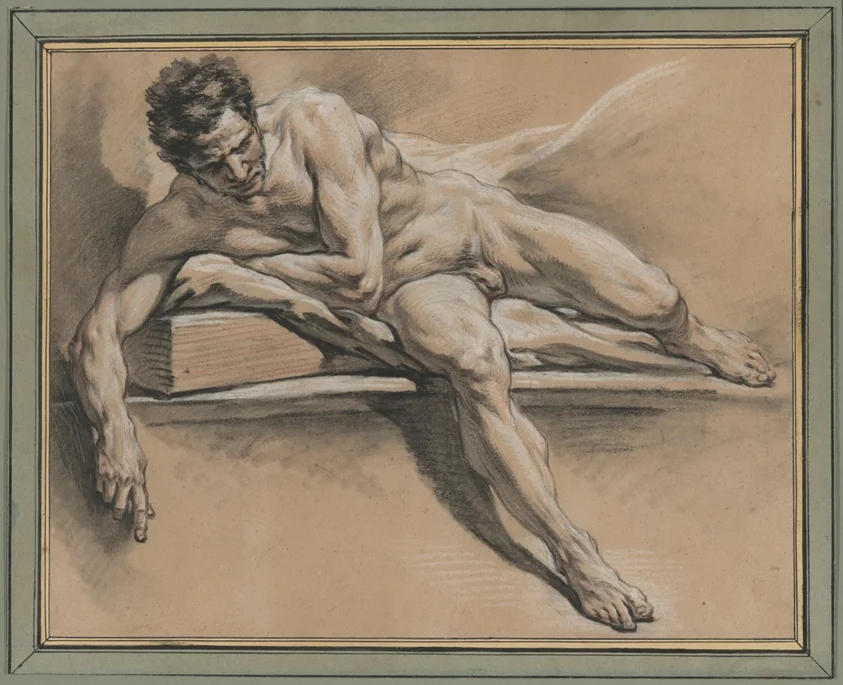
As an influential professor at the Royal Academy, Boucher taught life drawing. A savvy businessman, he realized the potential of producing etchings after his studies from life so that there might be instruction in provincial centers as well. This drawing—a dazzling demonstration of his technique of comingling red, black, and white chalks—was one of those reproduced.
Provenance
Probably acquired directly from the artist by Jean-Claude Gaspard de Sireul (c. 1710/20–1781), rue Lévêque, Paris (“Le portefeuille de Mr Boucher"); probably sold, Paris, December 3, 1781, no. 219; possibly Mr. Payant [a dealer who purchased several drawings from this sale]. Mme Verger, Dèves Chateau, near Avignon [inscription in pen and brown ink, verso of frame]. Private collection, Avignon, c. 1920–80; given to her nephew, Comte de Chambure, Aix-en-Provence, France, from c. 1985; sold Paris, Hôtel Drouot, October 10, 2000 (as French School, 18th century; no cat.) to Michel Gierzod, Nantes, France, to 2008.
Accession Number
196175
Medium
Black chalk, with stumping and touches of red chalk, heightened with white chalk, on cream laid paper, laid down on cream laid paper
Dimensions
35.6 × 44.8 cm (14 1/16 × 17 11/16 in.)
Classification
chalk
Credit Line
Regenstein Endowment Fund
Background & Context
Background Story
François Boucher's "Academic Study of a Reclining Male Nude" (c. 1750) is a black chalk drawing with stumping and touches of red chalk, heightened with white chalk, on cream laid paper. This is an academic figure study, the kind of rigorous anatomical exercise that was the foundation of artistic training in the 18th century. The model is posed in a reclining position, the body rendered with careful attention to anatomy, proportion, and the fall of light across the form. The combination of black and red chalk with white highlights on cream paper follows the traditional technique of drawing on tinted paper that had been practiced since the Renaissance. Boucher was one of the most accomplished draftsmen of his age, and this academic study demonstrates the technical skill that underlay his more decorative works. The careful modeling of the figure, the precise handling of the chalks, and the balanced composition all reflect the discipline of academic training that Boucher never abandoned, even at the height of his Rococo fame.
Cultural Impact
Boucher's academic figure studies demonstrate the rigorous training that underlay the apparently effortless grace of the Rococo style, showing that the master of decorative painting was also a master of traditional draftsmanship.
Why It Matters
This academic nude study reveals the foundation of Boucher's art: the careful study of the human form that gave his decorative works their underlying structure and conviction.