Provenance
Bought from the artist by Bernheim-Jeune, Paris for 500 francs on November 29, 1900 [see inscription on reverse and Bernheim-Jeune stock no. 11140, this and the following information according to Salomon and Congeval 2003]; sold to Georges Feydeau, Paris for 1,000 francs on May 13, 1901. Bernheim-Jeune, Paris, c. 1902 [stock no. 12307, see inscription on reverse]. Gaston Bernheim de Villers, Paris. Bernheim-Jeune, Paris, April 20, 1906 [stock no. 14935, see label on reverse]. Baron Bruno Caccamisi, Paris. Mme Blanche Marchesi, Paris. Bernheim-Jeune, Paris by 1924; sold to Martin A. Ryerson (died 1932), Chicago, 1924 [see receipt no. 1754, Registrar office, copy in curatorial file]; bequeathed to the Art Institute, 1933.
Accession Number
16643
Medium
Oil on cardboard
Dimensions
43.8 × 57.8 cm (17 1/4 × 22 3/4 in.); Framed: 61 × 74 cm (24 1/16 × 29 3/16 in.)
Classification
Painting
Credit Line
Mr. and Mrs. Martin A. Ryerson Collection
Background & Context
Background Story
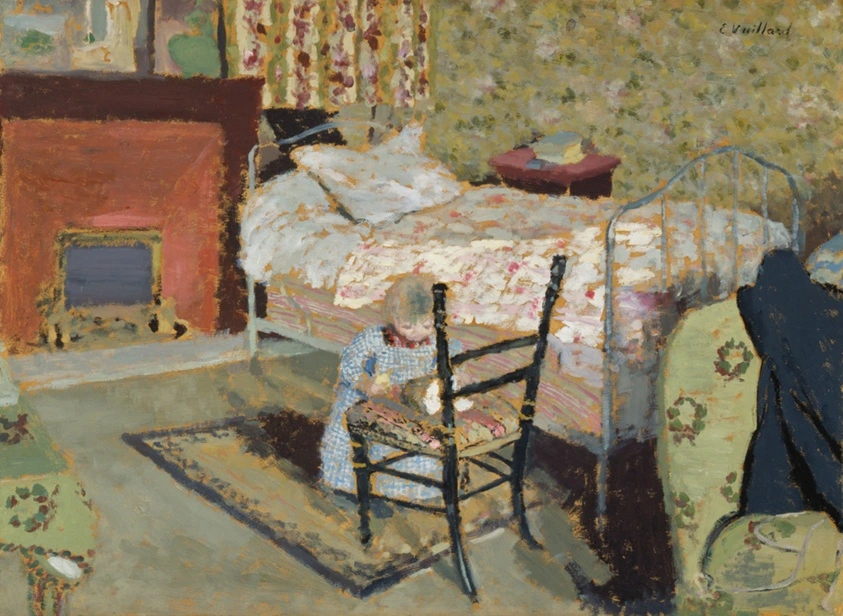
Édouard Vuillard's "Child Playing: Annette Roussel in Front of a Wooden Chair" (c. 1900) is an oil on cardboard painting depicting a child—the daughter of Vuillard's friend, the painter Ker-Xavier Roussel—absorbed in play. The subject of children playing was a recurring theme in Vuillard's work, allowing him to capture moments of spontaneous activity within the domestic interiors he loved. Annette Roussel is shown in front of a wooden chair, the child's figure rendered with the soft, simplified forms characteristic of Vuillard's approach. The oil on cardboard technique gives the painting a matte, intimate quality. Vuillard's treatment of children is never sentimental—he observes them with the same objective eye he brings to his still lifes and interiors, capturing their absorption in their own world without imposing adult meaning upon it. The wooden chair, a simple piece of furniture, becomes an important compositional element, its vertical lines and solid form anchoring the more fluid figure of the child.
Cultural Impact
Vuillard's paintings of children document the private world of childhood in the French bourgeoisie, capturing the absorbed concentration of play with the same sensitivity he brought to his portraits of adults.
Why It Matters
This painting of a child at play captures the absorbed concentration of childhood, the soft forms and intimate scale creating a work of quiet beauty that observes without sentimentality.


