Accession Number
112178
Medium
Pen and brown ink and brush and brown wash, heightened with lead white (oxidized), on tan laid paper
Dimensions
25.6 × 39.3 cm (10 1/8 × 15 1/2 in.)
Classification
ink with wash
Credit Line
The Leonora Hall Gurley Memorial Collection
Background & Context
Background Story
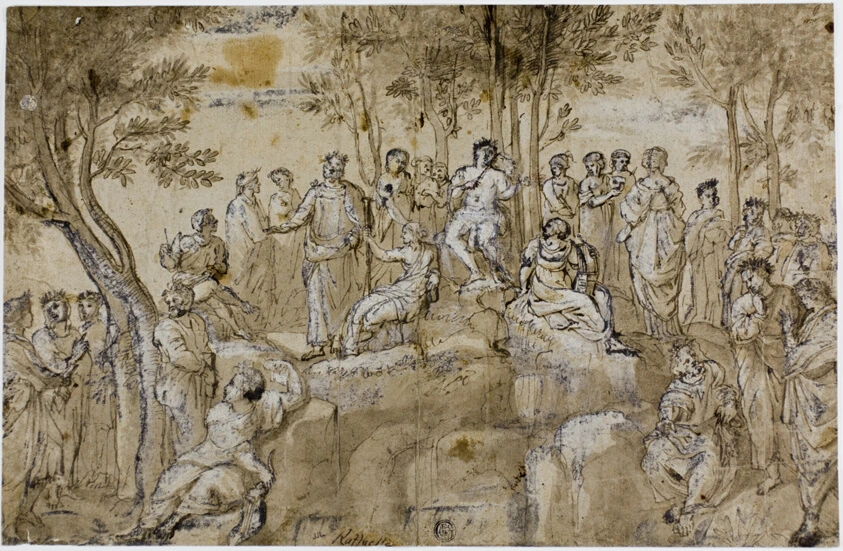
This drawing of Parnassus, attributed to Raphael and dated to the early seventeenth century after his original design for the Vatican Stanze, is one of the most important surviving documents of High Renaissance draftsmanship. The image shows Mount Parnassus with Apollo and the Muses, rendered in pen and brown ink with wash and white heightening on tan laid paper. The composition corresponds to the central fresco in the Stanza della Segnatura, one of Raphael's most famous decorations, and the drawing probably served as a preparatory study or a copy made for collectors. The handling of the ink lines is extraordinarily fluid, combining the precision of classical outline with the atmospheric softness of wash to create spatial depth without perspectival construction. This mastery of combined media was one of Raphael's contributions to Renaissance drawing: he learned from Leonardo's sfumato and Michelangelo's anatomical power, then synthesized them into a style of effortless grace that would dominate European draftsmanship for centuries. The subject of Parnassus—mythological home of poetry and music—was crucial to the program of the Stanza della Segnatura, where Raphael illustrated the four branches of knowledge (theology, philosophy, poetry, and law) as a visual encyclopedia of human culture. The drawing also documents the collecting practices of the seventeenth century, when finished compositional studies by masters like Raphael were treated as independent works of art. Art historians have debated whether this sheet is autograph or a copy by a talented follower; in either case, it preserves the essential qualities of Raphael's compositional thinking. The medium of pen, wash, and white heightening on tan paper was standard for Italian draftsmen of the period, but Raphael's execution raised it to a level of refinement that became the academic standard for centuries.
Cultural Impact
This preparatory drawing preserved High Renaissance compositional ideals while demonstrating Raphael's synthesis of Leonardo's sfumato and Michelangelo's anatomical power into academic grace.
Why It Matters
It matters because a sketch of a mountain with poets became the template for how Europe learned to draw—Raphael proving that preparation could be as perfect as the finished wall.