Accession Number
81291
Medium
Black chalk on tan laid paper, edge mounted on buff laid paper
Dimensions
43.2 × 28 cm (17 1/16 × 11 1/16 in.)
Classification
chalk
Credit Line
The Leonora Hall Gurley Memorial Collection
Background & Context
Background Story
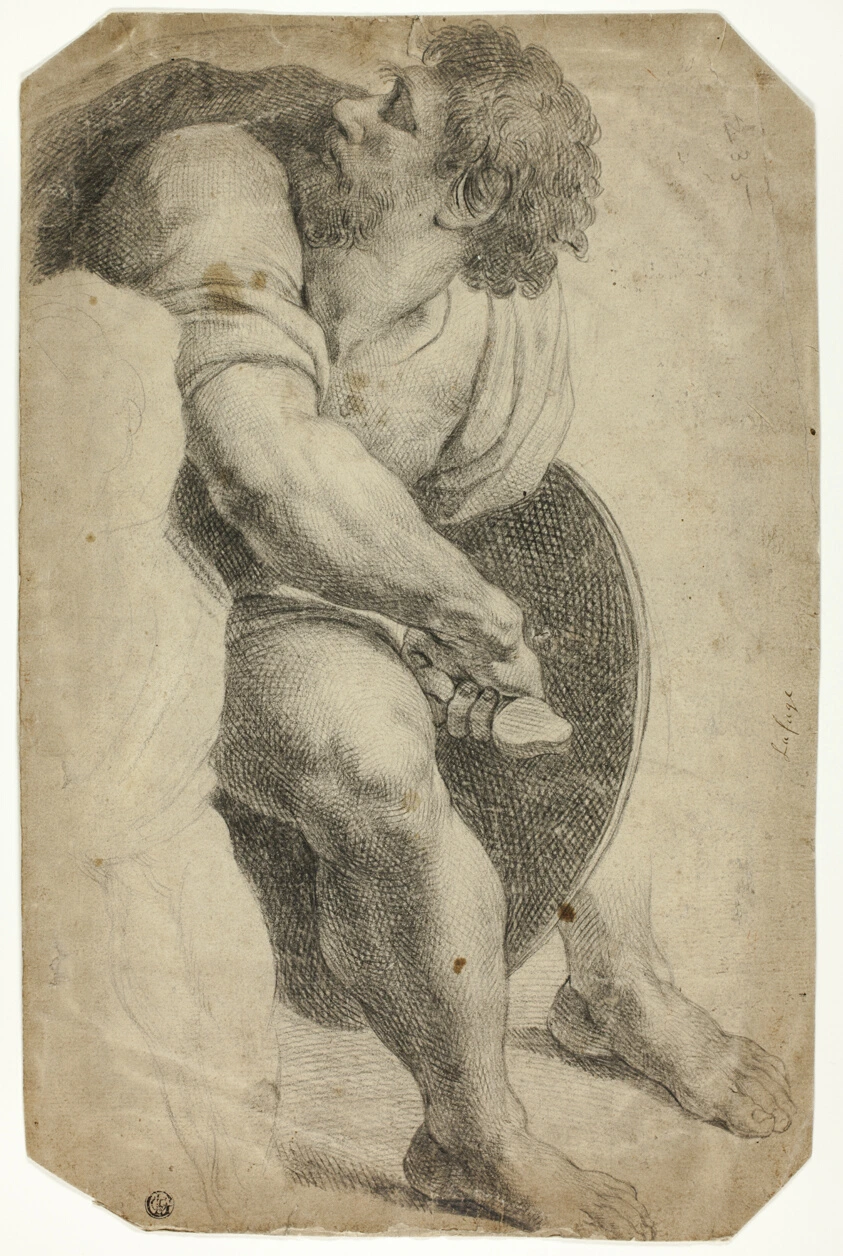
This drawing of a guard drawing his sword, attributed to Raphael, is executed in black chalk on tan laid paper and belongs to the extensive corpus of figure studies that document Raphael's working method in preparing his painted compositions. The figure is shown in a dynamic contrapposto, the torso twisted as the right arm reaches across the body to grasp the sword hilt, a pose that demonstrates Raphael's absorption of classical and Renaissance sources from antique bas-reliefs to the figures of Michelangelo. The chalk medium allows both precise contour and soft tonal modeling, with the tan paper serving as a middle value against which white highlights and black shadows create three-dimensional form. This economy of means—three values on a single sheet—was the foundation of Renaissance life drawing and would dominate European academic training through the nineteenth century. The subject of a soldier or guard occurs repeatedly in Raphael's drawings, reflecting the demands of his papal commissions where military and political figures needed to be integrated into religious narratives. The drawing also reveals Raphael's relationship to his workshop: many such studies were executed by assistants under his supervision, though the quality of this sheet suggests the master's own hand. Art historians have linked this figure to specific paintings in the Vatican and elsewhere, tracing how individual drawings were adapted and combined in larger compositions. The physical condition of the paper—mounting on heavier stock, discoloration at the edges—documents the sheet's history as a collected object, valued for its authorship rather than its practical function.
Cultural Impact
This chalk study codified Renaissance contrapposto for centuries of academic training, revealing Raphael's synthesis of antique bas-relief and Michelangelesque dynamism in a single economical sheet.
Why It Matters
It matters because a drawing of a man reaching for his sword became the grammar of European art—Raphael showing that every pose contained a history of bodies in motion.