Accession Number
82155
Medium
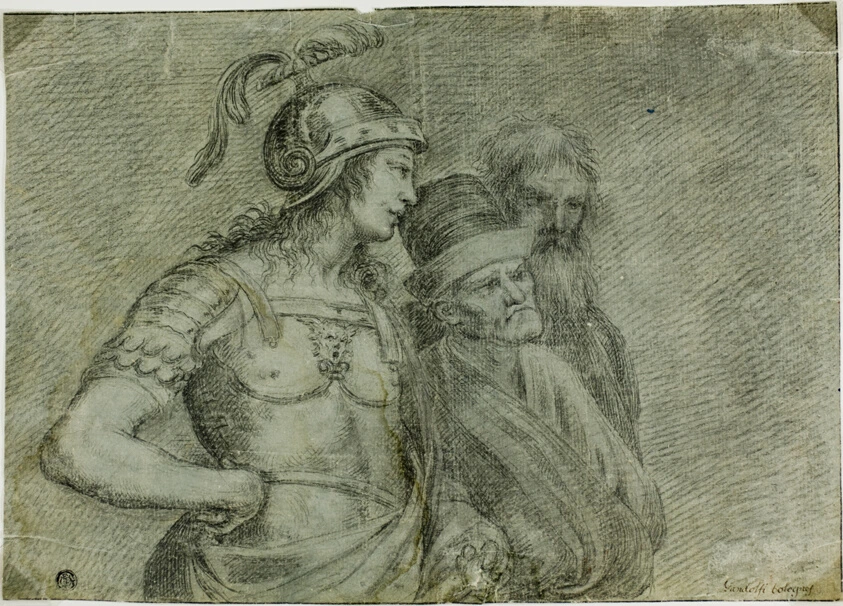
Metalpoint and black chalk, with traces of white chalk, on pale blue-toned cream laid paper
Dimensions
28 × 39.2 cm (11 1/16 × 15 7/16 in.)
Classification
chalk
Credit Line
The Leonora Hall Gurley Memorial Collection
Background & Context
Background Story
This drawing, attributed to Raphael and dated to the eighteenth century though based on earlier designs, depicts Alcibiades with two philosophers in metalpoint and black chalk on pale blue-toned cream laid paper. The subject belongs to the philosophical iconography of the Renaissance, in which classical thinkers were presented as visual exemplars of wisdom and virtue. Alcibiades, the brilliant but unstable Athenian statesman, was typically paired with Socratic figures who represented the moderating force of philosophy on political ambition. Raphael's treatment shows the young Alcibiades in animated conversation with two older men, the composition arranged in a pyramidal grouping that recalls the structure of his Madonnas while transferring sacred geometry to secular subject matter. The medium of metalpoint—drawing with a silver stylus on prepared paper—was common in the fifteenth and sixteenth centuries for its precision and permanence, though it required exceptional control since mistakes could not be erased. The black chalk additions provided tonal depth that metalpoint alone could not achieve, while traces of white chalk created highlights on the pale blue ground. This three-tool technique was standard for advanced Renaissance draftsmen and demonstrates the refinement that made Raphael's drawings collectable among connoisseurs. The sheet also reflects the eighteenth-century practice of copying and attributing old master drawings; even if this version is a later copy, it preserves compositional ideas that were central to Raphael's philosophical program. Art historians have debated whether the drawing relates to a specific lost painting or to the broader decorative schemes of papal and princely apartments.
Cultural Impact
This philosophical drawing preserved Renaissance pyramidal composition for secular subjects, demonstrating the metalpoint precision that made Raphael's draftsmanship the academic standard.
Why It Matters
It matters because Raphael drew a conversation between a politician and philosophers—proving that even gossip could be arranged like a sacred triangle.