Description
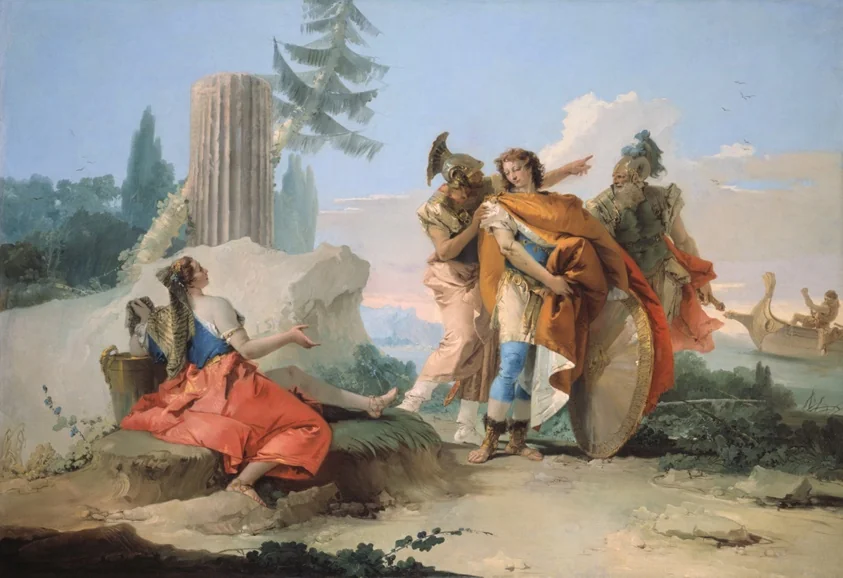
The third scene from Giovanni Battista Tiepolo’s four-part suite of decorations, this painting shows the emotional climax of the story. The knight Rinaldo has been persuaded by his companions, Carlo and Ubaldo, to renounce the love of the sorceress Armida. Bareheaded and pensive, Rinaldo has taken up his shield again and appears to hesitate as the older knights gesture toward the boat that will carry them back to the crusader army and Armida implores him to stay.
Provenance
Possibly one of four scenes from Tasso made for the 'gabinetto degli specchi' of the Palazzo Corner a San Polo, Venice [according to inventories and other documents discussed by Romanelli 1998]. Count Giovanni Serbelloni, Venice in 1838; by descent, until possibly 1886 [Molmenti 1911 and Knox 1978]. Giulio Cartier, Genoa by 1908 [Malaquzzi Valeri 1908]; Sedelmeyer Gallery, Paris, in 1912 [Ojetti 1912]; James Deering (d. 1925), Vizcaya, from 1913 [information sheet in curatorial file]; bequeathed, 1925.
Accession Number
16492
Medium
Oil on canvas
Dimensions
186.7 × 259.4 cm (73 1/2 × 102 1/8 in.); Framed: 195 × 270.5 × 9.5 cm (76 3/4 × 106 1/2 × 3 3/4 in.)
Classification
oil on canvas
Credit Line
Bequest of James Deering
Tags
Color: Orange Color: Gray
Background & Context
Background Story
Giovanni Battista Tiepolo's "Armida Abandoned by Rinaldo" (c. 1742–45) is the companion painting in the Rinaldo and Armida series, depicting the moment when Rinaldo, freed from Armida's enchantment, abandons her to join the Crusade. The scene is one of the most dramatic in Tasso's poem: Armida, who had been the powerful enchantress, is now abandoned and powerless, her love rejected by the knight who has returned to his duty. Tiepolo's painting captures the emotional crisis of the moment: Armida's despair, Rinaldo's conflicted determination. The composition is dynamic and expressive, the figures' gestures conveying the emotional intensity of the scene. The palette is rich and varied, the handling is confident and decorative. The Rinaldo and Armida series demonstrates Tiepolo's ability to handle complex narrative subjects with clarity and emotional power, while maintaining the decorative brilliance that made him the most sought-after painter in 18th-century Europe.
Cultural Impact
The Rinaldo and Armida series is a masterpiece of Rococo narrative painting, combining dramatic storytelling with exquisite decorative beauty.
Why It Matters
This painting of the moment of abandonment captures the emotional climax of Tasso's story, the despair of Armida and the determination of Rinaldo rendered with Tiepolo's characteristic dramatic intensity and decorative grace.


