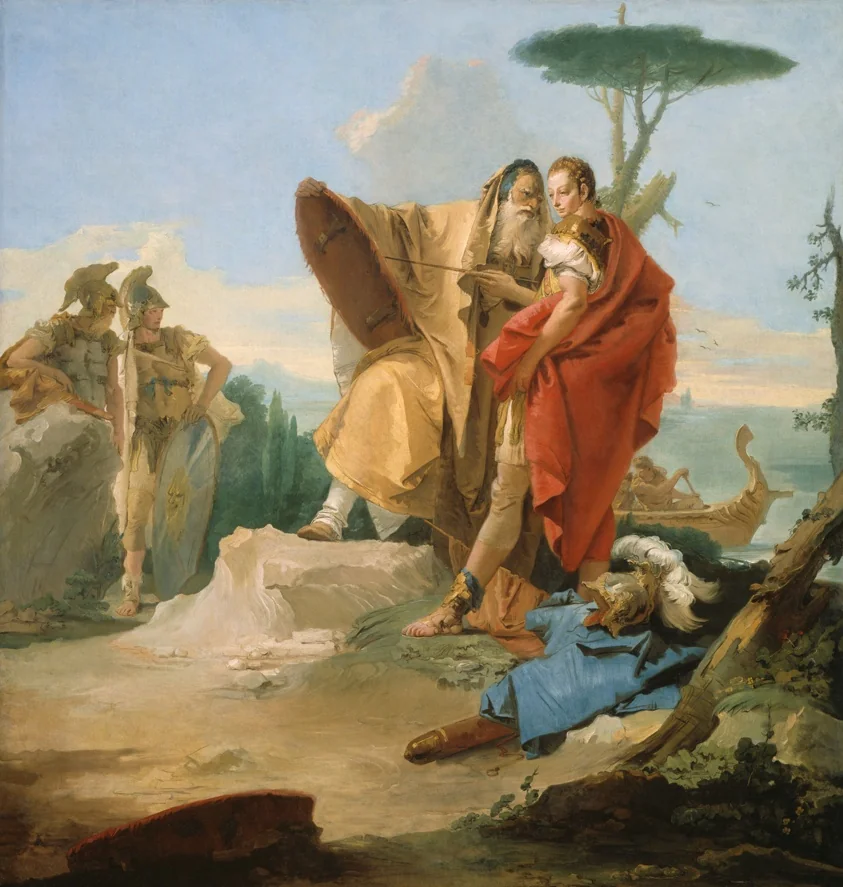
Rinaldo and the Magus of Ascalon

Description

The fourth and final large narrative canvas from Giovanni Battista Tiepolo’s decorative suite stresses the moral of the story and takes place as Rinaldo rejoins the crusader army. The boat bringing the knight from Armida’s island has just deposited him on the coast of Palestine. The magician of Ascalon uses Rinaldo’s shield to conjure the heroic deeds of his ancestors, urging him to live up to their legacy. In contrast to earlier canvases in the sequence, the young knight appears focused on his mission. In his choice to return to battle, the figure of Rinaldo would have served as a positive example of civic duty for the family who commissioned these decorations.

Provenance

Possibly one of four scenes from Tasso made for the 'gabinetto degli specchi' of the Palazzo Corner a San Polo, Venice [according to inventories and other documents discussed by Romanelli 1998]. Count Giovanni Serbelloni, Venice in 1838; by descent, until possibly 1886 [Molmenti 1911 and Knox 1978]. Giulio Cartier, Genoa by 1908 [Malaquzzi Valeri 1908]; Sedelmeyer Gallery, Paris, in 1912 [Ojetti 1912]; James Deering (d. 1925), Vizcaya, from 1913 [information sheet in curatorial file]; bequeathed, 1925.

Rinaldo and the Magus of Ascalon

Giovanni Battista Tiepolo

c. 1742–45

Accession Number

16495

Medium

Oil on canvas

Dimensions

182.9 × 188 cm (72 × 74 in.); Framed: 194 × 190.2 × 7.6 cm (76 3/8 × 74 7/8 × 3 in.)

Classification

oil on canvas

Museum

The Art Institute of Chicago

Chicago, United States

Credit Line

Bequest of James Deering

Background & Context

Background Story

Giovanni Battista Tiepolo's "Rinaldo and the Magus of Ascalon" (c. 1742–45) is another canvas from the Rinaldo and Armida series, depicting the moment when the Magus of Ascalon, a wise hermit, reveals to Rinaldo the illusory nature of Armida's enchantments and reminds him of his duty as a Christian knight. The Magus shows Rinaldo his reflection in a shield, not the enchanted knight in Armida's garden but the true knight he is meant to be. Tiepolo's composition captures the moment of revelation: the Magus pointing to the shield, Rinaldo confronted with the truth about himself. The lighting is dramatic, with the shield perhaps catching the light to emphasize its symbolic importance. The figures are posed with Tiepolo's characteristic elegance, the drapery flowing and graceful. This painting, like the others in the series, combines dramatic narrative with decorative beauty, creating a work that is both intellectually engaging and visually splendid.

Cultural Impact

Tiepolo's Rinaldo and Armida series exemplifies the Enlightenment fascination with the power of reason to dispel illusion, the Magus representing the force of truth and self-knowledge.

Why It Matters

This painting of Rinaldo and the Magus captures the moment of moral revelation, the shield reflecting the true identity of the knight and the Magus pointing the way to duty and honor.