Description
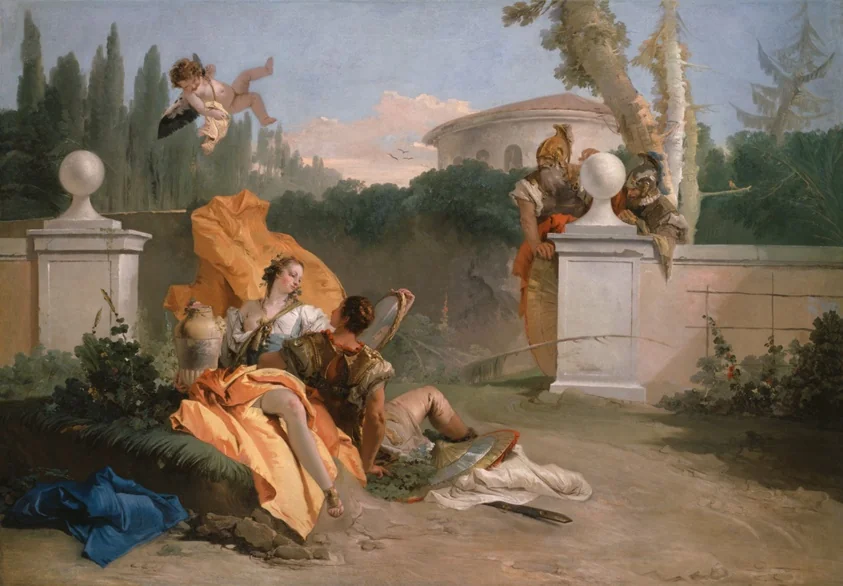
In this second of the four large paintings from Giovanni Battista Tiepolo’s sequence illustrating the story of the crusader Rinaldo and the sorceress Armida, Armida has abducted Rinaldo and carried him away to her magical garden. She looks into a magic mirror while the knight sits enthralled, gazing into her eyes, his sword and shield cast aside. Meanwhile, Rinaldo’s two companions, Carlo and Ubaldo, appear at the garden gate to persuade him to return to their quest to seize control of Jerusalem.
Provenance
Possibly one of four scenes from Tasso made for the 'gabinetto degli specchi' of the Palazzo Corner a San Polo, Venice [according to inventories and other documents discussed by Romanelli 1998]. Count Giovanni Serbelloni, Venice in 1838; by descent, until possibly 1886 [Molmenti 1911 and Knox 1978]. Giulio Cartier, Genoa by 1908 [Malaquzzi Valeri 1908]; Sedelmeyer Gallery, Paris, in 1912 [Ojetti 1912]; James Deering (d. 1925), Vizcaya, from 1913 [information sheet in curatorial file]; bequeathed,1925.
Accession Number
16485
Medium
Oil on canvas
Dimensions
186.7 × 259.4 cm (73 1/2 × 102 1/8 in.); Framed: 194.3 × 270.5 × 7.9 cm (76 1/2 × 106 1/2 × 3 1/8 in.)
Classification
oil on canvas
Credit Line
Bequest of James Deering
Tags
Color: Orange Color: Brown
Background & Context
Background Story
Giovanni Battista Tiepolo's "Rinaldo and Armida in Her Garden" (c. 1742–45) is another canvas from the celebrated Rinaldo and Armida series, depicting the enchanted lovers in Armida's magical garden. The garden is a place of perfect beauty and pleasure, where Armida has brought Rinaldo to forget his knightly duty and remain with her forever. Tiepolo's painting shows the lovers in a lush, idyllic landscape, attended by putti and surrounded by the beauties of nature. The composition is serene and harmonious, the figures reclining in poses of graceful ease. The palette is warm and luminous, with the greens of the garden setting off the figures' rich costumes. This painting represents the heart of the Rinaldo and Armida story: the moment of perfect (but illusory) happiness before the Magus of Ascalon shatters the enchantment. Tiepolo's treatment of the subject is among the most beautiful in 18th-century art, capturing the dreamlike beauty of Tasso's enchanted garden with extraordinary decorative splendor.
Cultural Impact
Tiepolo's Garden of Armida is one of the most enchanting images of earthly paradise in Western art, a vision of perfect beauty that both celebrates and questions the power of sensual pleasure.
Why It Matters
This painting of Rinaldo and Armida in her garden captures the dreamlike beauty of Tasso's enchanted world, the graceful figures and luminous landscape creating an image of paradise that is both seductive and hauntingly fragile.


