Description
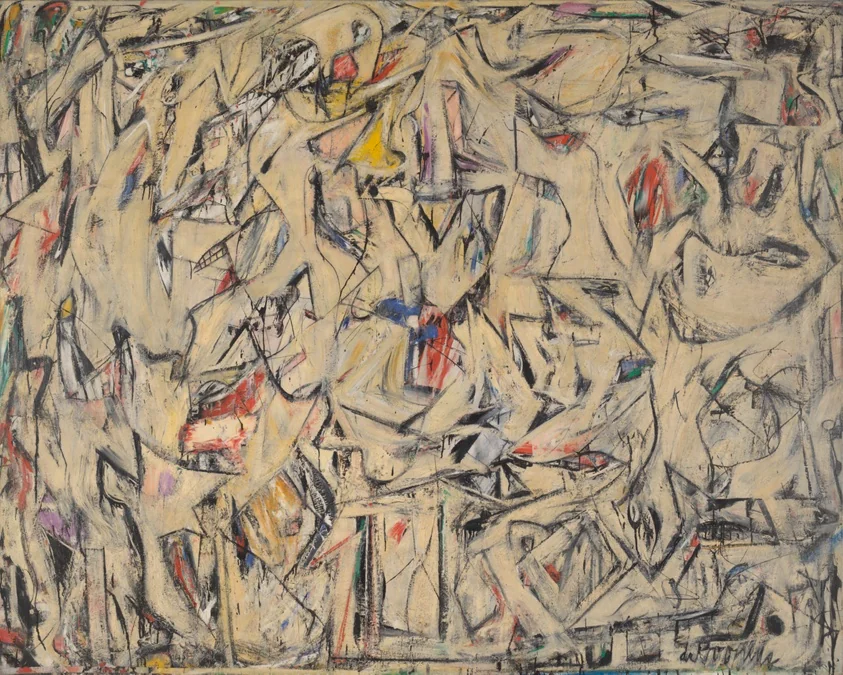
Willem de Kooning was a central figure in Abstract Expressionism, an art movement that espoused the painterly actions of the artist as a sign of his or her emotions. De Kooning completed Excavation in June 1950, just in time for it to be exhibited in the twenty-fifth Venice Biennale. His largest painting up to that date, the work exemplifies the Dutch-born innovator’s style, with its expressive brushwork and distinctive organization of space into sliding planes with open contours. According to the artist, the point of departure for the painting was an image of women working in a rice field in Bitter Rice, a 1949 Neorealist film by Italian director Giuseppe de Santis. The mobile structure of hooked calligraphic lines defines anatomical parts—bird and fish shapes, human noses, eyes, teeth, necks, and jaws—that seem to dance across the painted surface, revealing the particular tension between abstraction and figuration that is inherent in de Kooning’s work. The original white pigment has yellowed over the years, diluting somewhat the flashes of red, blue, yellow, and pink that punctuate the composition. Aptly titled, the painting reflects de Kooning’s technically masterful painting process: an intensive building up of the surface and scraping down of its paint layers, often for months, until the desired effect was achieved.
Provenance
Accession Number
76244
Medium
Oil on canvas
Dimensions
Without frame: 205.7 × 254.6 cm (81 × 100 1/4 in.)
Classification
oil on canvas
Credit Line
Mr. and Mrs. Frank G. Logan Purchase Prize Fund; purchased with funds provided by Edgar J. Kaufmann, Jr., and Mr. and Mrs. Noah Goldowsky


