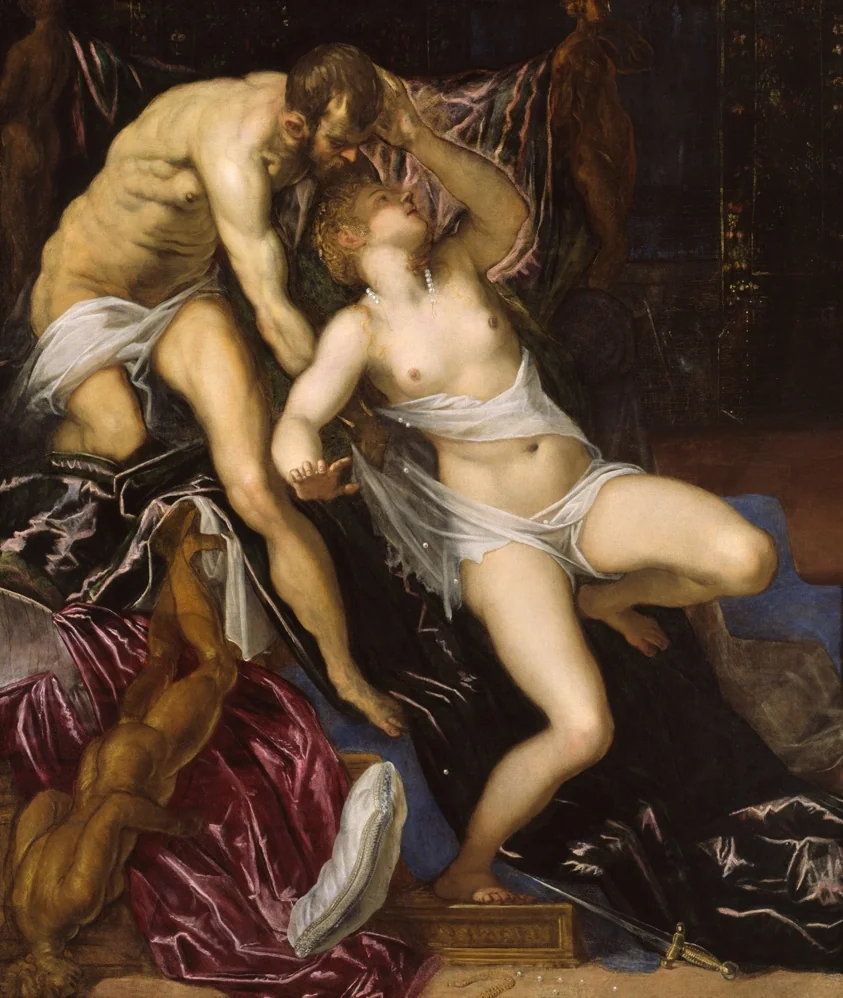
Tarquin and Lucretia

Description

According to Roman history, the rape of the virtuous matron Lucretia by Tarquin, son of the Roman king, incited the people to overthrow the monarchy and establish a republic around 510 BCE. Lucretia was hailed as a hero for subsequently committing suicide in an attempt to avoid any perceived dishonor to her family. Tintoretto depicted one of the most violent moments of the story with his characteristic expressive distortions of anatomy and space and vibrant treatment of light: As Tarquin and Lucretia struggle, a pillow flies through the air, her pearl necklace breaks apart, and the fabric and carved posts of the bed’s canopy collapse around them.

Provenance

Possibly Antonio Tronsarelli, Rome (died 1601) ["Un quadro grande in tela colorito a olio di Tarquinio quando Viola Lucretia di mano del Tentoretto (sic)"; see Matteo Lafranconi, "Antonio Tronsarelli: A Roman collector of the late sixteenth century," Burlington Magazine 140 (1998), p. 545, no. (5)]. Private collection, France [according to Illustrated London News, 4 December 1937]. Robert Lebel, Paris, by 1937 [Illustrated London News, 4 December 1937]. Richard Goetz, Paris and New York, by 1939 [1939 Knoedler exh. cat.]. Sold by E. and A. Silberman Galleries, New York, to the Art Institute, 1949.

Tarquin and Lucretia

Tintoretto

1578–80

Accession Number

64920

Medium

Oil on canvas

Dimensions

175 × 151.5 cm (68 7/8 × 59 5/8 in.); Framed: 203.9 × 181 × 8.3 cm (80 1/4 × 71 1/4 × 3 1/4 in.)

Classification

oil on canvas

Museum

The Art Institute of Chicago

Chicago, United States

Credit Line

Art Institute Purchase Fund

Background & Context

Background Story

"Tarquin and Lucretia" is a 1578–80 oil on canvas by Tintoretto that captures the Venetian master in his most dramatically violent and emotionally intense mode, the image showing the legendary rape of Lucretia by Tarquin with the same muscular energy and dark chiaroscuro that made Tintoretto's history paintings among the most powerful and disturbing works of the Renaissance. The composition is a large canvas—175 × 151.5 centimeters—showing Tarquin attacking Lucretia in a bedroom setting with the dramatic lighting and the swirling movement that suggest both the physical violence of the assault and the moral urgency of the narrative. The oil on canvas creates a surface of extraordinary depth and coloristic richness, the paint suggesting both the physical textures of the fabrics and the emotional turbulence of the scene. The 1578–80 date places this work in the period of Tintoretto's mature production, when he was producing the history paintings that established his reputation as the leading narrative painter of the Venetian school. Art historians have connected this painting to the broader tradition of the history painting in Renaissance art, from the works of Titian to the sculptures of Michelangelo, noting that Tintoretto's treatment is more focused on the dramatic action and the emotional intensity, the physical struggle and the moral tragedy, than the classical balance or the idealized beauty of these other traditions.

Cultural Impact

This 1578–80 oil canvas made Tarquin-Lucretia violently intense through large 175cm dark chiaroscuro bedroom drama and muscular swirling energy, using mature narrative Venetian school to transform legendary assault into moral urgency beyond Titian classical idealization.

Why It Matters

It matters because Tintoretto painted a rape and made the canvas feel like it was screaming—proving that even a bedroom could be a battlefield if the chiaroscuro was dark enough.