Hercules and the Lernaean Hydra

Description

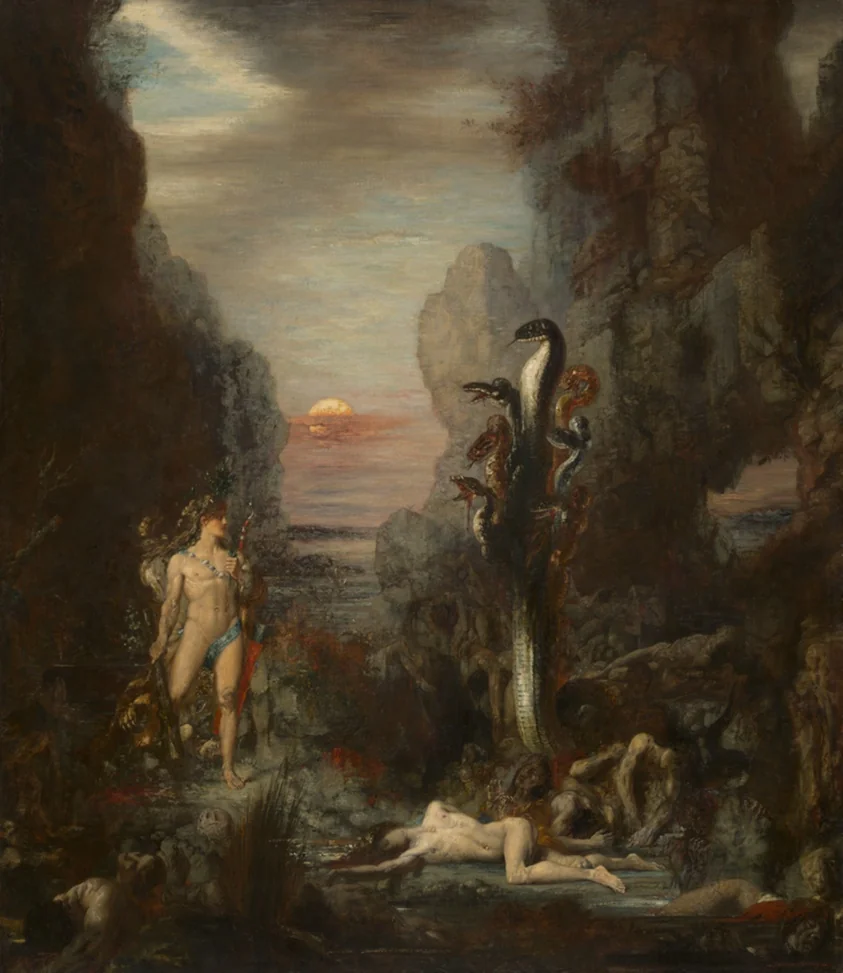
In order to atone for killing his family, the mythical ancient Greek hero Hercules was tasked with completing twelve difficult feats. His second task was to slay the Lernaean Hydra, a water monster with multiple serpentine heads. Gustave Moreau depicted their encounter in this work, exhibited at the Paris Salon of 1876, indulging his taste for the ghoulish. Hercules confronts the Hydra in a swampy landscape, rendered as a primordial ooze of brown paint and strewn with the fragmented and decomposing bodies of previous victims. Calm and youthful, Hercules stands amid the carnage, weapon in hand, ready to sever the Hydra’s seventh, “immortal” head, which he will later bury.

Despite the violent subject, the painting seems eerily still, almost frozen. Reinforcing this mysterious quality is Moreau’s ability to combine suggestive, painterly passages with obsessive detail. His precise draftsmanship and otherworldly palette are the result of his painstaking methods; he executed numerous preliminary studies for every detail in the composition, even sketching live snakes at the Paris zoo.

Moreau might have intended this mythological painting to express contemporary political concerns: he was profoundly aff ected by France’s military defeat at the hands of Prussia in 1870–71. Hercules might literally personify France; the Hydra could represent Prussia. Whether or not this was the artist’s intention, this monumental work portrays a moral battle between the forces of good and evil with intensity and power, combining history, myth, mysticism, and a fascination with the bizarre.

Provenance

Sold by the artist to Louis Mante (1857-1939), Marseille on July 26, 1887 for 30,000 francs; by descent to his heir, Juliette Mante (died 1956), Marseille, his widow retaining custody; Mante sale, Paris, Galerie Charpentier, November 28, 1956, lot 6 (ill.). Richard L. Feigen, Chicago and New York by 1961 [see New York 1961]. Jacques Seligmann, New York. Mrs. Eugene A. Davidson, Chicago by 1964; given to the Art Institute, 1964.

Hercules and the Lernaean Hydra

Gustave Moreau

1875–76

Accession Number

20579

Medium

Oil on canvas

Dimensions

179.3 × 154 cm (70 9/16 × 60 5/8 in.); Framed: 226.7 × 201.9 cm (89 1/4 × 79 1/2 in.)

Classification

oil on canvas

Museum

The Art Institute of Chicago

Chicago, United States

Credit Line

Gift of Mrs. Eugene A. Davidson

Background & Context

Background Story

"Hercules and the Lernaean Hydra" is an 1875–76 oil on canvas by Gustave Moreau that captures the French Symbolist master in his most monumentally dramatic and chromatically opulent mode, the image showing the Greek hero battling the multi-headed monster with the same jewel-like colors and hallucinatory detail that made Moreau the defining painter of the Symbolist imagination. The composition is a very large canvas—179.3 × 154 centimeters—showing Hercules and the Hydra with the oil on canvas creating a surface of extraordinary scale and visual density. The monumental scale enhances the sense of mythic grandeur and cosmic struggle, the painting becoming a meditation on the eternal battle between order and chaos. The 1875–76 date places this work in the period of Moreau's most intensive production of mythological subjects and his establishment as the leading painter of the French Symbolist movement. Art historians have connected this painting to the broader tradition of the mythological battle in European art, from the paintings of Rubens to the sculptures of the period, noting that Moreau's treatment is more focused on the jewel-like color and the hallucinatory detail, the transformation of mythic narrative into visual orgy, than the physical drama or the moral allegory of these other traditions.

Cultural Impact

This 1875-76 oil canvas made Hercules hydra monumentally opulent through very large 179cm jewel-like hallucinatory chromatic density and mythic cosmic grandeur, using intensive mythological production to transform Greek battle into visual orgy beyond Rubens physical moral allegory.

Why It Matters

It matters because Moreau painted a hero fighting a monster and made the canvas feel like it was drowning in jewels and terror—proving that even a battle could be beautiful if theSymbolism was decadent enough.