Description
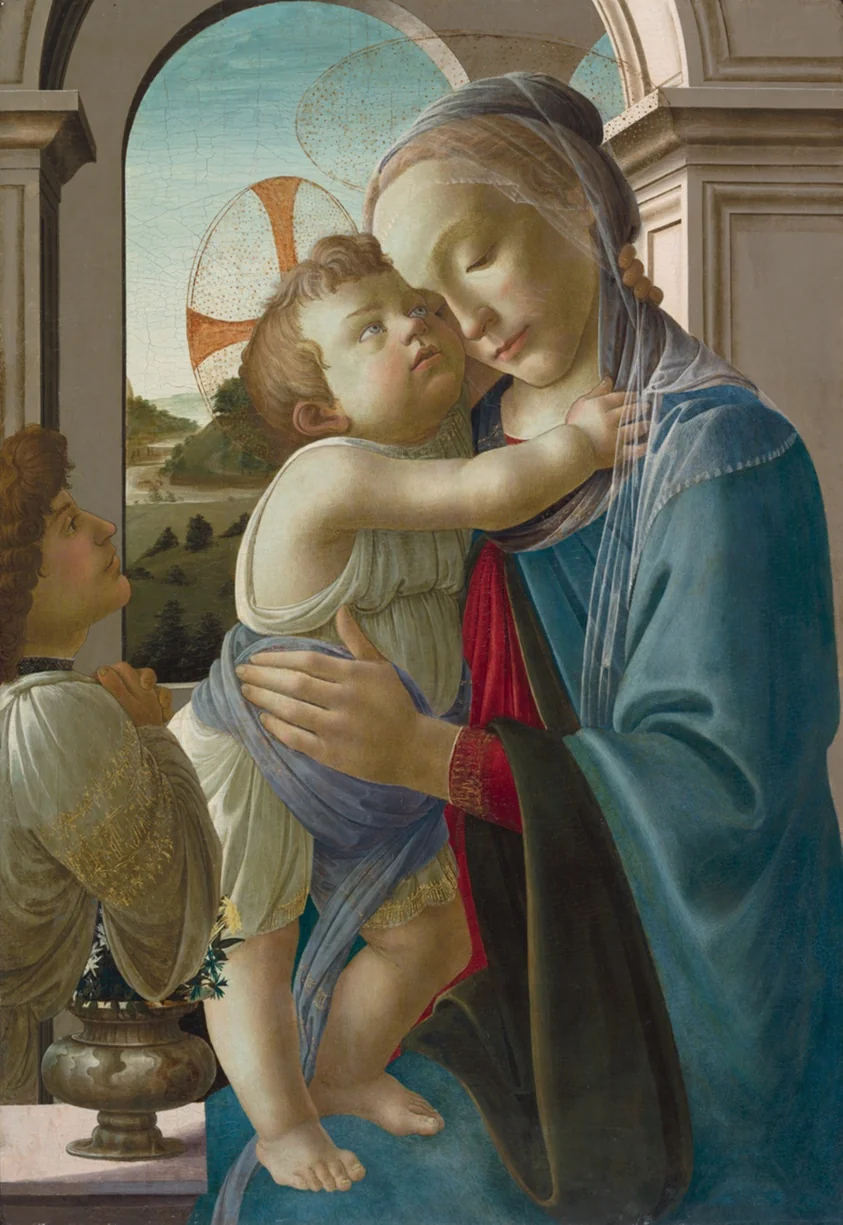
In this humanizing yet idealized depiction of the Virgin Mary embracing the baby Jesus, Sandro Botticelli conveyed the sacred beauty of maternal love. Mary, her expression soft and her skin luminous, nuzzles her son’s chubby cheek as he grasps the nape of her neck. An angel, smaller in scale, looks on adoringly. Highly celebrated in his own lifetime, Botticelli developed a distinctly sentimental and tactile style of painting for both religious and secular subjects.
Provenance
Possibly Dr. Paoletti, Florence [according to a note in the curatorial file, recording the remark of a Dr. Richter, presumably Jean Paul, during a visit to the Epstein home in June 1935]. Jules Féral, Paris, 1907–19 [according to Lightbown 1978]; sold by Féral to a Scandinavian collector, 1919 [according to Lightbown 1978]. Arnold van Buuren, Naarden, Holland; sold, Sotheby Mak van Waay, Amsterdam, May 26–27, 1925, lot 20, for 25,500 guilders [according to an annotated copy of the sale catalogue in the Getty Research Institute]. Max Epstein (d. 1954), Chicago, from 1925 or 1928 to 1954 [Levey and Mandel 1967 stated that Epstein purchased the work in 1925, but it may not have arrived in the United States until May 1928, corresponding to registrar’s records dated May 15, 1928]; bequeathed to the Art Institute, 1954; on loan to his widow, Leola Epstein, Chicago, 1955–68.
Accession Number
80530
Medium
Tempera on panel
Dimensions
85.8 × 59.1 cm (33 3/4 × 23 1/4 in.); Framed: 106.7 × 80.1 × 7.7 cm (42 × 31 1/2 × 3 in.)
Classification
tempera
Credit Line
Max and Leola Epstein Collection
Tags
Color: Gold
Background & Context
Background Story
Sandro Botticellis Virgin and Child with an Angel from 1475-85 is a tempera on panel painting that exemplifies the Florentine masters approach to the Madonna and Child, a subject that he treated throughout his career with variations in composition, scale, and mood that demonstrate the range and flexibility of his artistic invention within the conventions of 15th-century devotional painting. The Virgin and Child, depicted in the refined Linear style and graceful figural proportions that distinguish Botticellis best work, are accompanied by an angel who holds the Christ Child or presents flowers to the Virgin in a composition that combines the intimacy of the domestic Madonna with the formality of the altarpiece. Botticelli, who was the most celebrated painter in Florence during the golden age of the Medici and the teacher of a generation of Florentine artists, developed a style of painting in which the Linear beauty of the figure is more important than the volumetric modeling of form, creating images in which the grace of the outline and the elegance of the pose take precedence over the physical presence of the body. The tempera on panel medium, which was the standard medium for Italian panel painting before the widespread adoption of oil painting in the late 15th century, allows Botticelli to create the precise edges and brilliant color that distinguish his style, in which the surface of the painting has the smoothness and luminosity of enamel rather than the textural richness of oil. The years 1475-85 bracket the period of Botticellis greatest achievement, when he was producing the mythological paintings and Madonnas that made him the most admired painter in Florence.
Cultural Impact
Botticellis Madonnas are among the most celebrated works of the Italian Renaissance, and their influence on the development of Madonna painting extends through the 16th century to the present. Virgin and Child with an Angel demonstrates the refined Linear style and graceful figural proportions that made his work the model of Florentine elegance.
Why It Matters
A tempera on panel painting by Botticelli from 1475-85 of the Virgin and Child with an angel, combining domestic Madonna intimacy with altarpiece formality in the refined Linear style and graceful figural proportions that made him the most admired painter in Medici Florence.