The Grand Canal, Venice

Description

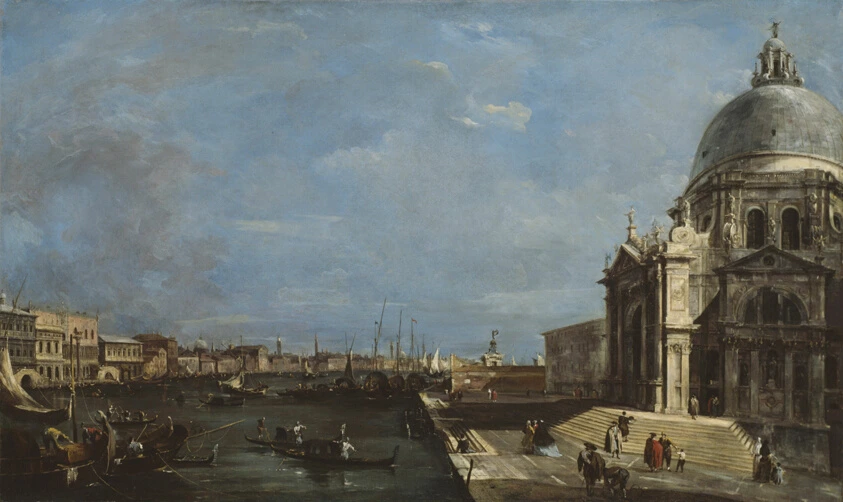
Although he did not begin to paint views (vedute) until he was in his mid-40s, Francesco Guardi soon became an accomplished practitioner in the genre. He was strongly influenced by the precisely rendered Venetian scenes of Canaletto and Michele Marieschi. In this work, one of his most important early cityscapes, Guardi depicted the mouth of the Grand Canal hustling with late-afternoon activity. The church of Santa Maria della Salute and the customhouse are visible on the right. The emotional tenor of Guardi’s vedute—seen here in the brooding, melancholy aura of the sky—distinguishes them from the works of his predecessors.

Provenance

S(amuel) C(harles) Weston, Esq, London by 1840 [according to Graves 1913, p. 452]; by descent to his son, Alexander Anderdon Weston, Esq., London, died 1901 [according to Venice 1993, no. 30, pp. 106-7]; his widow Isabella Frances Weston, died 1922; sold by order of the Trustees of Isabella Frances Weston, Christie’s, London, October 21, 1949, no. 31, to Koetser for £7,200 pounds [according to annotated catalogue at the Ryerson Library, Art Institute of Chicago]; Koetser Gallery, New York; sold to the Art Institute in 1951.

The Grand Canal, Venice

Francesco Guardi

c. 1760

Accession Number

111074

Medium

Oil on canvas

Dimensions

73 × 119.4 cm (28 3/4 × 47 in.)

Classification

oil on canvas

Museum

The Art Institute of Chicago

Chicago, United States

Credit Line

Wirt D. Walker Fund

Background & Context

Background Story

Francesco Guardi's "The Grand Canal, Venice" (c. 1760) is an oil on canvas that depicts the most famous waterway in Venice, lined with the palaces of the city's most powerful families. The Grand Canal was the main artery of Venetian life, and it was the subject of countless paintings by Guardi, his rival Canaletto, and other Venetian view painters. This painting shows a stretch of the canal with its characteristic palaces, gondolas, and activity on the water. Guardi's treatment is notably more atmospheric and less topographically precise than Canaletto's—where Canaletto aimed for documentary accuracy, Guardi aimed for the evocation of atmosphere and the character of the city. His brushwork is looser, his colors more varied, his skies more dramatic. This painting captures the unique quality of Venetian light, the way it reflects off the water and illuminates the facades of the palaces. The figures in gondolas add life and scale to the scene. Guardi's Grand Canal views were among his most popular works, sought after by the Grand Tourists who visited Venice and wanted to take home a memento of its beauty.

Cultural Impact

Guardi's Grand Canal views represent the final flowering of the Venetian veduta tradition, pushing the genre from documentary accuracy toward a more personal, atmospheric vision that anticipated the Romantic sensibility.

Why It Matters

This view of the Grand Canal captures the unique beauty of Venice, the loose brushwork and luminous palette conveying the play of light on water and the magnificent architecture that lines the city's main waterway.