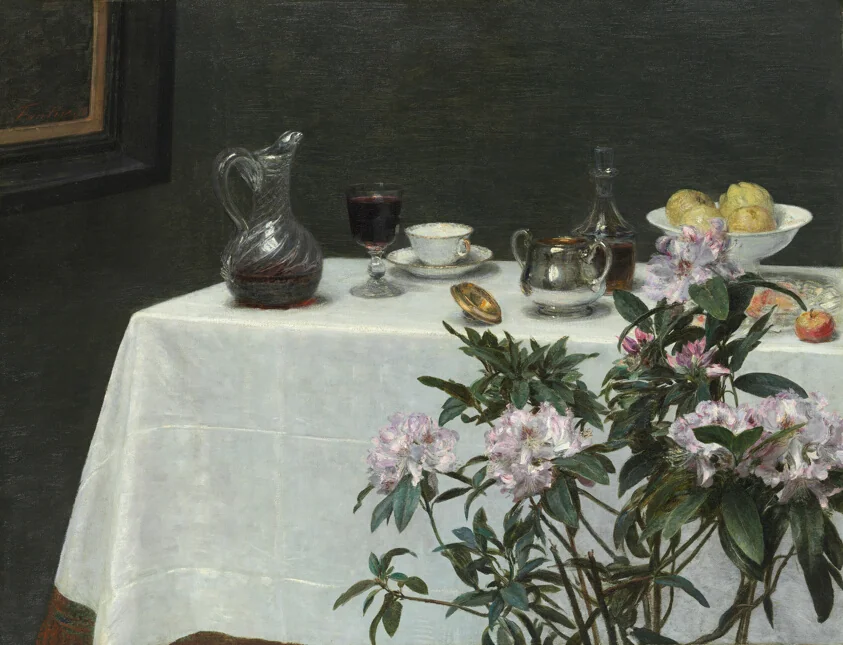
Still Life: Corner of a Table

Description

This canvas, exhibited at the Salon of 1873, relates to Henri Fantin-Latour’s largest and most famous painting of the decade, The Corner of a Table (1872; Musée d’Orsay, Paris), an immense composition that includes detailed portraits of several young Parisian poets and writers. The table around which they are posed displays many of the still-life elements featured in this work. The delicate rhododendron plant reflects the influence of Japanese prints, from its dramatic silhouette against the neutral backdrop of the white tablecloth to its unusual placement in the foreground, emphasizing the scene’s unorthodox cropping.

Provenance

Elizabeth Ruth Edwards (c. 1833-1907), Fantin-Latour’s art agent, London. Gustave Tempelaere (died 1904), Paris in 1901 [Tempelaere inventory no. 4679; see letter from Sylvie Brame to Gloria Groom, dated April 10, 2002, in curatorial file]. Antonio Mancini (died 1930), Rome by 1906 until at least 1924 [acc. to Bénédite1906 and Gibson 1924]. Possibly E. Lernoud, Paris [acc. to Ottawa 1983; mentioned in Paris 1955 as the owner preceding Mancini, but this cannot be confirmed]. Mme. Vincent Daniel, Rennes by 1936 [acc. to letter from Philippe Brame to Gloria Groom, dated April 30, 2001, in curatorial file; in Grenoble 1936 she is incorrectly listed as Madame Vincent Danielo, Vannes; in Ottawa 1983, she is incorrectly located in Vennes]; sold to Hector Brame, Paris in 1951 [acc. to letter from Philippe Brame citied above]; Hector Brame and César de Hauke, Paris; sold to the Art Institute in September 1951.

Still Life: Corner of a Table

Henri Fantin-Latour

1873

Accession Number

75507

Medium

Oil on canvas

Dimensions

96.4 × 125 cm (37 15/16 × 49 3/16 in.); Framed: 122 × 152.4 × 9.6 cm (48 × 60 × 3 3/4 in.)

Classification

oil on canvas

Museum

The Art Institute of Chicago

Chicago, United States

Credit Line

Ada Turnbull Hertle Endowment

Background & Context

Background Story

Henri Fantin-Latour's Still Life: Corner of a Table (1873) is an oil on canvas that exemplifies the artist's mastery of floral and still life painting. Fantin-Latour (1836-1904) was a French painter known for his exquisite flower paintings, his portraits of artists and writers, and his imaginative compositions inspired by music and literature. This still life shows a corner of a table with flowers, perhaps in a vase, arranged with the delicate precision that characterizes his work. The palette is rich and subtle, with the whites and soft colors of the flowers set against the darker tones of the background. Fantin-Latour's technique is meticulous, building the forms of the flowers through careful layers of paint that capture their texture and luminosity. This painting belongs to the period when Fantin-Latour was at the height of his success as a still life painter, his works sought after by collectors in both France and England. His flower paintings were admired by the Impressionists for their freshness and by traditionalists for their technical mastery.

Cultural Impact

Fantin-Latour's still lifes represent a unique synthesis of traditional Dutch flower painting and modern French realism, creating works of exquisite beauty that transcend their apparent modesty.

Why It Matters

This still life of flowers on a corner of a table captures the delicate beauty of nature with extraordinary precision, Fantin-Latour's meticulous technique creating a sense of freshness and luminosity that makes the flowers seem almost alive.