Crouching Woman

Description

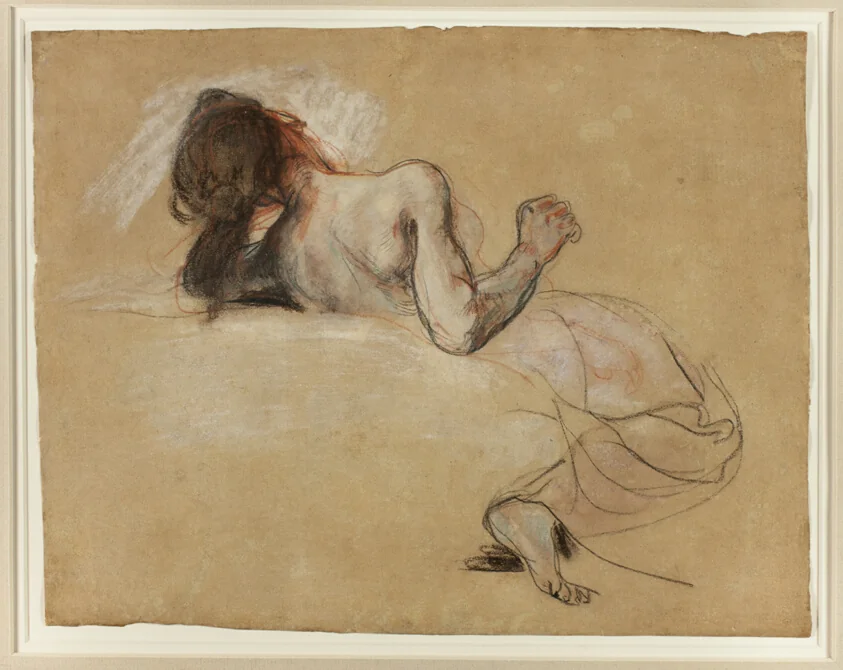
Crouching Woman is one of five pastel studies for Eugène Delacroix’s monumental painting The Death of Sardanapalus (1827; Musée du Louvre, Paris), which helped establish his reputation as the leader of the French Romantic movement. Of the few pastels that Delacroix produced, this is the only group that can be related to a single painting. Inspired by an 1821 play by the English Romantic poet Lord Byron, the canvas dramatically depicts the last king of the Assyrians. Reclining on his bed moments before his own suicide, the king gazes passively at his wives, concubines, and livestock as they are slain by his order to prevent their slaughter by the enemy army that has just defeated them. In this expressive image of one of the concubines, Delacroix convincingly captured the horror of the moment. With a sure, sweeping line, he described the rhythmic, taut posture of a figure recoiling from a blow or the stab of a knife. Although this powerful figure is significantly truncated in the final painting, the pastel provides insight into Delacroix’s creative process, and its sensual drama is representative of the Romantic period.

Provenance

Bequeathed by the artist to Charles Laurent Marechal (called Marechal de Metz) (died 1887); by descent to his son, Bar-le-Duc; sold to M. Landry. Victor Decock, by 1936 [Brussels 1936]. Sold, Galerie Charpentier, Paris, May 12, 1948, Decock sale, lot 2. Private Collector, Paris; sold, Francis Briest, Paris, April 10, 1989, lot 1. Sold by Brandt Dayton, New York, to the Art Institute, 1990.

Crouching Woman

Eugène Delacroix

1827

Accession Number

76779

Medium

Black and red chalk, with pastel, heightened with white chalk, over wash, on tan wove paper

Dimensions

24.6 × 31.4 cm (9 11/16 × 12 3/8 in.)

Classification

pastel

Museum

The Art Institute of Chicago

Chicago, United States

Credit Line

Through prior bequest of Mr. and Mrs. Martin A. Ryerson Collection

Background & Context

Background Story

This 1827 study of a crouching female nude is one of Delacroix's most powerful chalk drawings, executed in black and red chalk with pastel highlights on tan paper during the period when he was preparing his first major Salon submissions. The figure is shown from behind, her body folded into a compact mass that recalls the crouching Venus of classical antiquity while anticipating the modernist distortions of Picasso and Matisse. The chalk medium allowed Delacroix to move rapidly between broad tonal masses and precise linear accents, building the form through successive layers that retain their individual gestures. The red chalk (sanguine) is used for the warmer flesh tones of the back and thighs, while black chalk defines the shadows and contours, and white chalk highlights emerge from the tan paper like reflected light. This academic life drawing was standard training for European artists, but Delacroix's treatment is distinguished by its emotional intensity: the crouching pose suggests vulnerability and introspection rather than the heroic nudity of classical tradition. The drawing also reveals Delacroix's fascination with the female form as a vehicle for expressive movement rather than ideal beauty; the proportions are slightly elongated, the anatomy slightly strained, creating a sense of arrested motion that would animate his painted compositions. Art historians have connected this sheet to the preparatory studies for "The Death of Sardanapalus" (1827), in which crouching and contorted female bodies play central roles, suggesting that the drawing served both academic exercise and practical preparation for a major canvas.

Cultural Impact

This chalk study transformed academic life drawing into expressive modernism, using color-coded media to build a crouching figure that anticipated twentieth-century formal distortion.

Why It Matters

It matters as a woman bending away from the viewer—Delacroix showing that the back of a body could be as emotional as a face in tears.