A Sheet of Anatomical Studies

Description

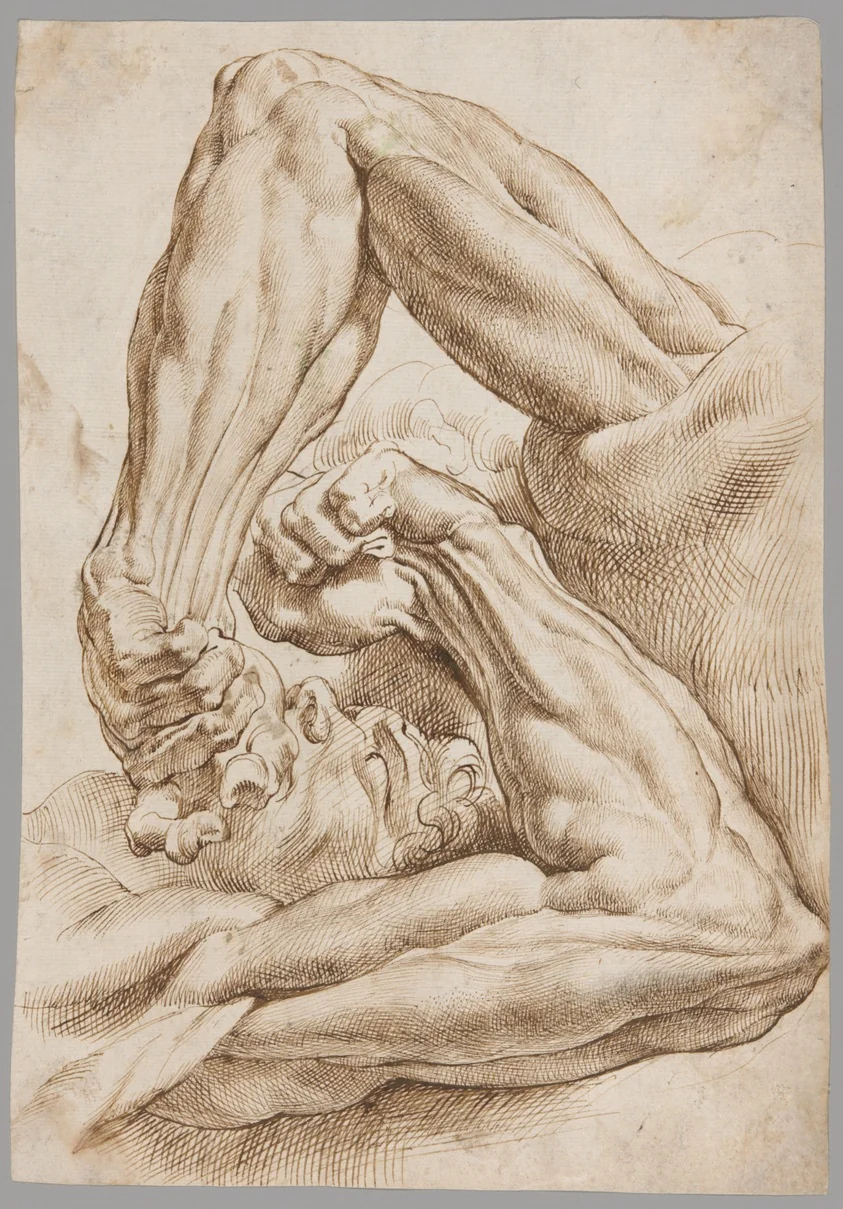
In addition to his study of Classical antiquity, Peter Paul Rubens also developed his sense of ideal anatomical form through proto-scientific treatises, some of which represented the muscles of the body with the skin flayed. Rubens adopted this manner, known as écorché, for his compelling representation of two interlocking forearms and a face. A virtuoso performance of the use of pen and ink (perhaps the most unforgiving media since it cannot be easily blended or erased), the drawing belongs to a group of about a dozen similar sheets that Rubens intended to publish as an anatomical treatise. The project was never realized, but one of the members of his workshop distributed a series of engravings years after the artist’s death that included these images together with other highlights of the artist’s repertoire.

Provenance

Sir Roger Newdigate (sometimes spelled Newdegate), 5th Baronet (1719–1806), from 1738/40; Newdegate Settlement, London; sold, Christie’s, London, July 6, 1987, lot 65; Bernard Quaritch Ltd, London; Hazlitt, Gooden & Fox, London, 1992; Elmer Seibel, Boston; Katrin Bellinger, Munich; Christopher Rupp, New York, 1997; sold, Sotheby’s, New York, Jan. 23, 2001, lot 156; W. M. Brady & Co., New York; Horace Wood Brock, Gloucester, Massachusetts and New York, 2001 until 2016; Sold by Stephen Ongpin, London, to the Art Institute of Chicago, 2016.

A Sheet of Anatomical Studies

Peter Paul Rubens

1600/10

Accession Number

235541

Medium

Pen and brown ink on ivory laid paper

Dimensions

27.1 × 18.8 cm (10 11/16 × 7 7/16 in.)

Classification

pen and ink drawings

Museum

The Art Institute of Chicago

Chicago, United States

Credit Line

Regenstein Acquisition Fund

Background & Context

Background Story

This sheet of anatomical studies from 1600–10 is one of Peter Paul Rubens's most revealing early drawings, documenting the systematic study of the human body that underpinned his entire career as a painter of muscular heroes, suffering saints, and sensuous nudes. The composition shows multiple studies of arms, legs, torsos, and heads, each rendered with the pen and brown ink precision that Rubens had learned from his training in the Flemish tradition and refined through his study of Italian Renaissance draftsmanship. The individual studies are arranged across the sheet without compositional connection, suggesting that this was a working drawing from the artist's studio, a resource that he would mine for figures in his larger paintings. The technique is extraordinarily economical: a few confident lines establish the structure of each limb, the anatomy described with the minimum of detail necessary to suggest function and form. This economy is characteristic of Rubens's working method: he drew constantly, filling thousands of sheets with studies that served as a visual library from which he could assemble complex compositions without the need for live models. The ivory laid paper provides a warm, smooth surface that makes the brown ink appear to glow, creating an aesthetic pleasure that transcends the drawing's utilitarian purpose. Art historians have connected this sheet to the broader tradition of Renaissance anatomical study, from Leonardo's dissected figures to Michelangelo's muscular nudes, noting that Rubens's treatment is more focused on the surface appearance of the body than the internal structure that fascinated Leonardo. The work also demonstrates the internationalism of Rubens's early training: the combination of Flemish precision and Italian dynamism that would make him the most sought-after painter in Europe.

Cultural Impact

This 1600–10 working sheet documented Rubens's systematic anatomical visual library, using economical brown-ink precision to bridge Flemish training with Italian Renaissance dynamism for later complex composition assembly.

Why It Matters

It matters because Rubens drew arms and legs like they were notes in a dictionary—proving that even the greatest painter had to study before he could make flesh fly.