Nude Youth in the Pose of the Spinario

Description

Italy, specifically ancient Roman sculpture, profoundly influenced Flemish artist Peter Paul Rubens. The artist himself wrote that “in order to attain the highest perfection in painting, it is necessary to understand the antiques . . . to be so thoroughly possessed of this knowledge that it may diffuse itself everywhere.”

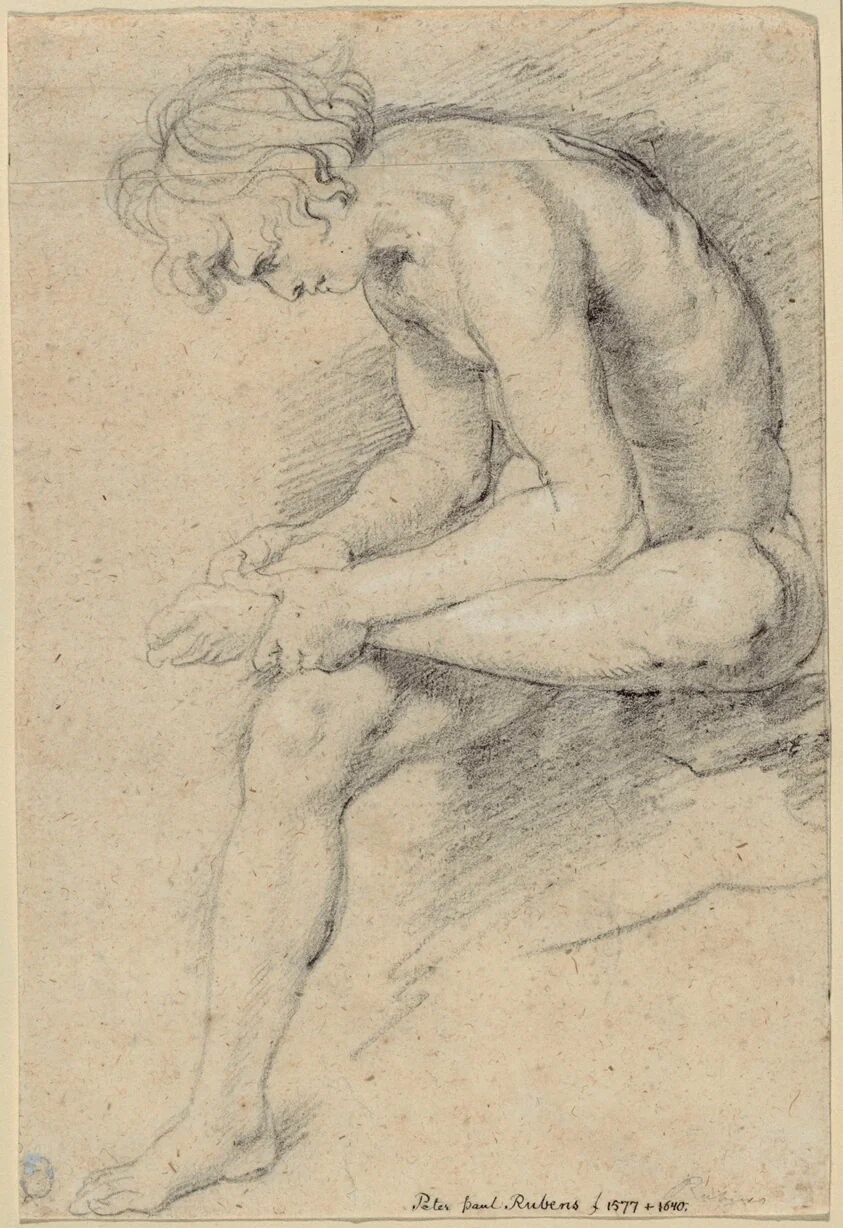
This drawing of a live studio model derives from the artist’s firsthand acquaintance with the Hellenistic bronze Spinario (also called Boy with Thorn, 1st century BCE), which was one of the most celebrated and copied sculptures in Rome. Absorbing antiquity without outright copying it, Rubens fully transformed his image from cold stone to vibrant flesh.

Provenance

Unidentified collector [partially erased stamp, recto, lower left]. Private collection, Sweden, by 1977 [Jaffé 1977 and Cuzin 2000 as private collection, London]; sold, Christie’s, London, July 8, 2003, lot 96, to Richard and Mary Gray, Chicago; given to the Art Institute of Chicago, 2019.

Nude Youth in the Pose of the Spinario

Peter Paul Rubens

1610/16

Accession Number

202249

Medium

Black chalk, heightened with white chalk, on tan laid paper

Dimensions

28 × 18.8 cm (11 1/16 × 7 7/16 in.)

Classification

drawings (visual works)

Museum

The Art Institute of Chicago

Chicago, United States

Credit Line

Gift of Richard and Mary L. Gray

Background & Context

Background Story

This drawing of a nude youth in the pose of the Spinario—removing a thorn from his foot—is one of Rubens's most accomplished chalk studies, executed between 1610 and 1616 in black chalk heightened with white on tan laid paper. The subject refers to one of the most famous sculptures of antiquity, a bronze boy from the Hellenistic period that had been discovered in Rome and was widely copied by Renaissance artists. Rubens's version transforms the classical original through his characteristic emphasis on physical weight and sensual warmth: the boy's body is fuller, fleshier than the antique model, his pose more relaxed and less athletic. This "Rubensian" transformation of classical prototypes was central to Baroque aesthetics: the idealized bodies of Greek and Roman art were softened into living flesh, made approachable rather than intimidating. The chalk technique is masterful: the black chalk establishes the forms in broad, velvety masses, while the white heightening picks out highlights on the back, buttocks, and raised leg, creating a convincing illusion of three-dimensional volume on the flat sheet. This use of two-color chalk on toned paper was standard in Italian academic practice, but Rubens's execution surpassed most contemporaries in its combination of anatomical precision and painterly atmosphere. Art historians have linked this drawing to the broader Baroque revival of classical subjects, particularly in Flanders where Counter-Reformation taste favored the edifying beauty of antique themes. The sheet also demonstrates Rubens's influence on later draftsmanship: his chalk studies were collected and copied by generations of European artists who sought to learn from his apparently effortless command of the medium.

Cultural Impact

This chalk study transformed the classical Spinario into Baroque flesh, using black and white heightening to demonstrate how Rubensian warmth could humanize antique idealism.

Why It Matters

It matters because Rubens drew a boy picking a thorn and made him look like he felt it—proving that even classical statues could learn to wince.