Description
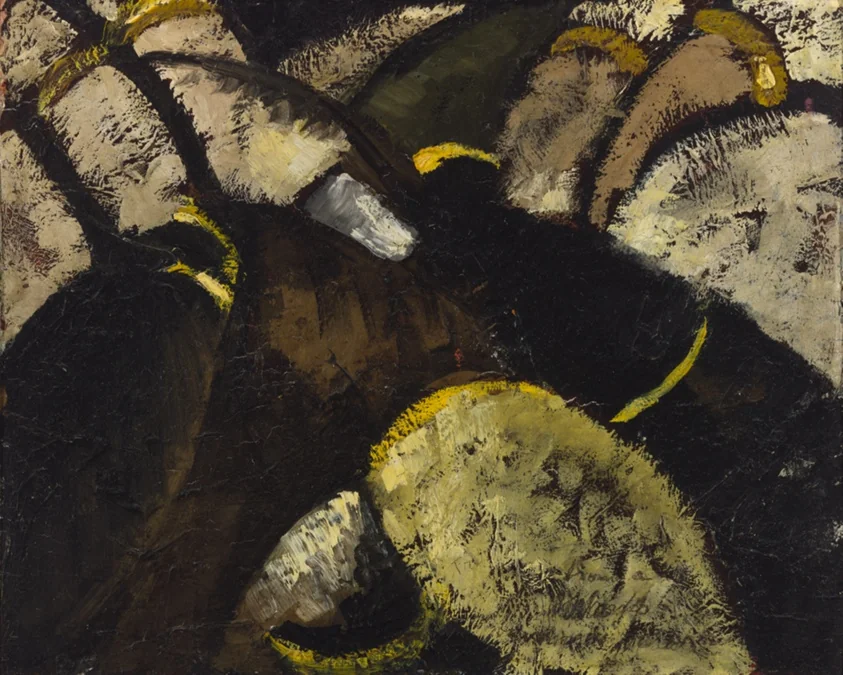
Arthur Dove lived in France from 1908 to 1909, where he absorbed the lessons of Pablo Picasso and other avantgarde artists working in Paris at the time, including fellow American Max Weber. Upon his return to New York, Dove joined the circle of artists at Alfred Stieglitz’s 291 gallery, and he became the first American painter to experiment with pure abstraction in works like From a Wasp. Employing subdued colors, perhaps in acknowledgement of the tones of Analytic Cubism, Dove created a tightly focused, highly abstract composition that renders the curving forms of a wasp’s body as a series of overlapping planes.
Accession Number
65871
Medium
Oil on wood
Dimensions
22 × 26.7 cm (8 5/8 × 10 1/2 in.)
Classification
Painting
Credit Line
Alfred Stieglitz Collection
Background & Context
Background Story
"From a Wasp" is a c. 1914 oil on wood by Arthur Dove that captures the American modernist pioneer in his most intimately observed and abstractly suggestive early mode, the image showing a composition inspired by the form of a wasp rendered with the same attention to organic form and natural abstraction that characterized his earliest and most influential works. The composition is a small painting—22 × 26.7 centimeters—showing an abstract composition with the oil on wood creating a surface of extraordinary intimacy and natural suggestion. The wood support provides a warm, natural ground that enhances the organic quality of the abstraction and the sense of connection to the natural world. The c. 1914 date places this work in the period of Dove's earliest production of abstract paintings and his establishment as the first American artist to create purely abstract works. Art historians have connected this painting to the broader tradition of the abstracted nature in modern art, from the paintings of the European avant-garde to the works of the American modernists, noting that Dove's treatment is more focused on the organic suggestion and the natural observation, the transformation of observed insect into abstract form, than the formal innovation or the theoretical abstraction of these other traditions.
Cultural Impact
This c. 1914 oil wood made wasp abstractly organic through small 22cm intimate natural suggestion and wood-support warm ground, using earliest abstraction period to transform observed insect into American pioneer organic form beyond European avant-garde theoretical formal innovation.
Why It Matters
It matters because Dove looked at a wasp and made the wood feel like it was buzzing with the secret geometry of nature—proving that even a bug could be a cathedral if the abstraction was honest enough.


