The First Part of the Return from Parnassus

Description

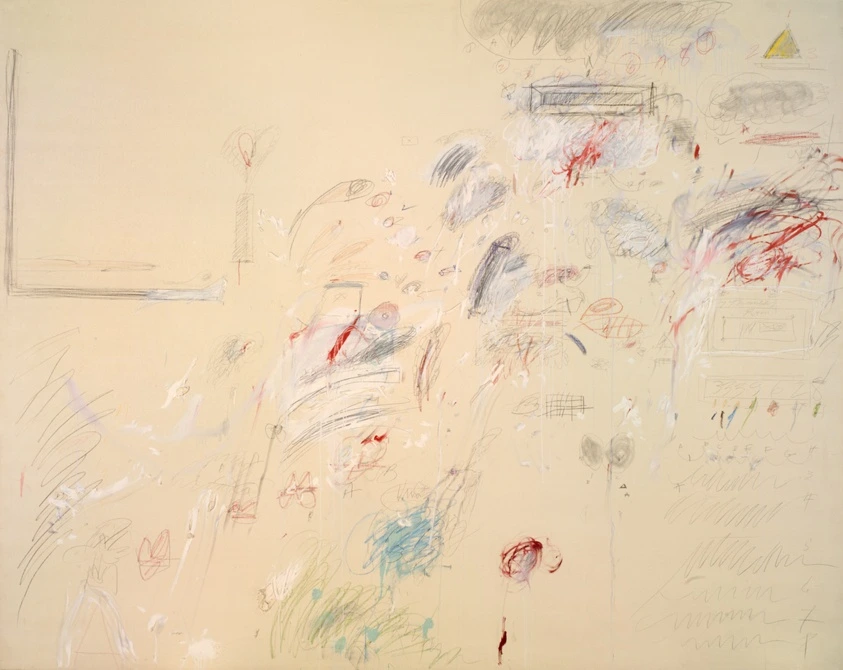
Cy Twombly’s famously inimitable art is tensely balanced between expressively abstract and suggestively pictorial impulses. His work originated under the auspices of Abstract Expressionism in the late 1940s and early 1950s and advanced uniquely along lines afforded by its freedoms. Twombly’s entire enterprise is characterized by unruly marks—stammering, energetic, and raw—that merge drawing, painting, writing, and symbolic glyphs. Scrawled, overwritten, erased, or willfully misspelled, words cite people, places, events, and stories nominally derived from Greco-Roman culture and history, especially literature, poetry, and myth.

The First Part of the Return from Parnassus

Cy Twombly

1961

Accession Number

186049

Medium

Oil paint, lead pencil, wax crayon, colored pencil on canvas

Dimensions

240.7 × 300.7 cm (94 3/4 × 118 3/8 in.)

Classification

Painting

Museum

The Art Institute of Chicago

Chicago, United States

Credit Line

Through prior gift of Mary and Leigh Block; Marian and Samuel Klasstorner and Major Acquisitions Endowment Income funds; Wirt D. Walker Trust; Estate of Walter Aitken; Director's Fund; Helen A. Regenstein Endowment; Laura T. Magnuson Acquisition Fund

Background & Context

Background Story

Cy Twomblys The First Part of the Return from Parnassus from 1961 is a large-scale painting that fuses the graphomanic energy of his earlier blackboard paintings with a new chromatic and literary dimension inspired by classical mythology. The title invokes Parnassus, the mountain sacred to Apollo and the Muses, and the Return suggests a journey back from creative inspiration to everyday consciousness. The paintings surface is a palimpsest of marks made in oil paint, lead pencil, wax crayon, and colored pencil, materials that Twombly employs for their distinct physical qualities: the oil paint bleeds and pools, the pencil scratches fine lines into the surface, the wax crayon resists the oil to create luminous interruptions, and the colored pencil adds accents of chromatic intensity. Words and fragments of words appear throughout the composition, some legible and others obscured by subsequent marks, creating a visual equivalent of the palimpsest of memory and forgetting that characterizes the classical tradition Twombly invoked. Created in 1961, the painting belongs to the period when Twombly had settled permanently in Italy and was immersing himself in Mediterranean culture and history, absorbing the landscape of Rome and the archaeological traces of ancient civilizations into a painting practice that refused the distinction between writing and drawing, mark-making and meaning.

Cultural Impact

Twomblys Parnassus paintings are central to the understanding of postwar art that engages with classical tradition without nostalgia. By treating mythology as a living language rather than a dead canon, Twombly opened a path for artists who sought to work with historical and literary material without surrendering to the formalist conventions that dominated American painting in the 1960s.

Why It Matters

A monumental painting by Twombly from his Parnassus series that combines oil, pencil, wax crayon, and colored pencil in a palimpsest of marks and words, invoking the classical mountain of the Muses as a metaphor for creative inspiration and the layered experience of cultural memory.