Business

Description

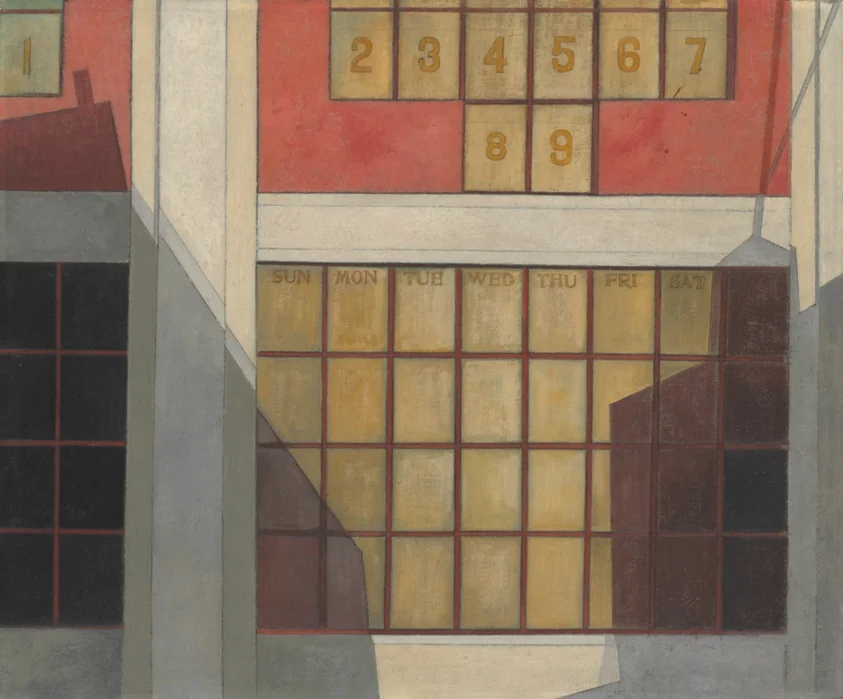
Charles Demuth was fascinated by the industrial landscape of his native Lancaster, Pennsylvania, and depicted here a factory building head-on in a starkly linear composition. In choosing a flat subject that mimics the surface of the canvas, Demuth embraced the modernist ideal of unifying form and content. But the artist then irreverently painted a calendar onto the building’s windows—the days of the week surrounded by looming shadows. At a time when many Americans exalted industrialization in the name of progress, Business can instead be read as a critique of the dreary routines that already shaped 20th-century work. At his death, Demuth bequeathed this painting to his longtime friend and supporter Georgia O’Keeffe who later gave it to the Art Institute.

Provenance

The artist; bequeathed to Georgia O'Keeffe, Abiquiu, N.M., and New York, N.Y., 1935; given to the Art Institute of Chicago, 1949.

Business

Charles Demuth

1921

Accession Number

65861

Medium

Oil and graphite on canvas

Dimensions

51 × 61.5 cm (20 × 24 1/4 in.)

Classification

oil on canvas

Museum

The Art Institute of Chicago

Chicago, United States

Credit Line

Alfred Stieglitz Collection

Background & Context

Background Story

Charles Demuth's "Business" (1921) is an oil and graphite on canvas that exemplifies the Precisionist fascination with American commercial and industrial architecture. The painting depicts a commercial building—perhaps a factory, office building, or storefront—rendered with Demuth's characteristic clarity and geometric precision. The title "Business" suggests a focus on the commercial activity that defined American urban life in the early 20th century. The combination of oil and graphite allows for both painterly passages and precise linear definition, the graphite providing the crisp edges that define Demuth's style. The building is simplified into geometric planes, the windows and doors reduced to rectangles of light and dark. The painting's composition is balanced and orderly, suggesting the efficiency and rationality of modern commerce. Demuth's Precisionist works celebrated the beauty of the American industrial landscape at a time when many artists were still looking to Europe for their subjects.

Cultural Impact

Demuth's Precisionist works helped define a distinctly American modernist aesthetic, finding artistic value in the commercial and industrial buildings that defined the American landscape.

Why It Matters

"Business" transforms an ordinary commercial building into an icon of American modernity, the geometric precision of Demuth's style perfectly suited to the clean lines and functional forms of commercial architecture.