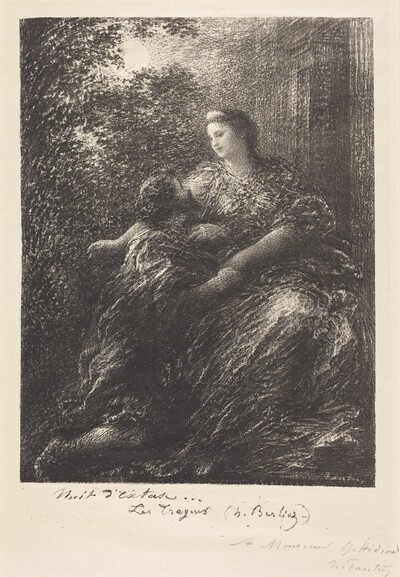
Provenance
From the artist to Jean-Baptiste Antoine Guillemet; (C.W. Kraushaar, New York); sold 15 September 1927 to Chester Dale [1883-1962], New York; bequest 1963 to NGA.
Accession Number
1963.10.25
Medium
oil on canvas
Dimensions
overall: 40.7 x 32.7 cm (16 x 12 7/8 in.) | framed: 62.9 x 54 x 5.7 cm (24 3/4 x 21 1/4 x 2 1/4 in.)
Classification
Painting
Credit Line
Chester Dale Collection
Tags
Painting Impressionist & Modern (1851–1900) Oil Painting Canvas French
Background & Context
Background Story
Fantin-Latour's Self-Portrait (1858) is an early work revealing the young artist's self-scrutiny and technical discipline. Painted when the artist was 22, the self-portrait demonstrates the precise drawing and subdued palette that would characterize his mature work. The act of self-portraiture—presenting oneself as both subject and artist—allowed Fantin-Latour to explore identity, vocation, and artistic self-consciousness at a formative moment. The year 1858 places this work during Fantin-Latour's early career, when he was studying at the École des Beaux-Arts and absorbing the academic traditions he would partially reject. His self-portrait shows neither the bravado of a young artist declaring his genius nor the uncertainty of a student finding his way; instead, it presents an artist in the process of becoming—serious, disciplined, and inward-looking. The painting's subdued tonality—the limited palette of grays, browns, and muted flesh tones—already announces Fantin-Latour's preference for chromatic restraint, which would distinguish his work from the brighter palettes of his Impressionist friends.
Cultural Impact
Fantin-Latour's self-portrait influenced how artists' self-representation was understood in 19th-century French art, offering a model of introspective sobriety that contrasted with the more theatrical self-portraits of Delacroix and Courbet. The self-portrait influenced later French artists who similarly used self-representation as a form of artistic self-examination rather than self-promotion. The painting also influenced how Fantin-Latour's artistic development was understood by historians and critics.
Why It Matters
This painting matters because it captures a moment of artistic self-formation—the point where training becomes vocation and discipline becomes style. For artists at the beginning of their careers, Fantin-Latour's self-portrait offers a model of seriousness without pretension: the young artist faces himself with the same attentive honesty he would later bring to flowers and faces.