Provenance
(Sale, Paris, 6 June 1929); purchased by Mlle. Berr de Turique. (Galerie Le Portique); sold 1929 to Chester Dale [1883-1962], New York; bequest 1963 to NGA.
Accession Number
1963.10.35
Medium
oil on linen
Dimensions
overall: 46.3 x 38.4 cm (18 1/4 x 15 1/8 in.) | framed: 59 x 51.4 cm (23 1/4 x 20 1/4 in.)
Classification
Painting
Credit Line
Chester Dale Collection
Tags
Painting Early Modern (1901–1950) Oil Painting French
Background & Context
Background Story
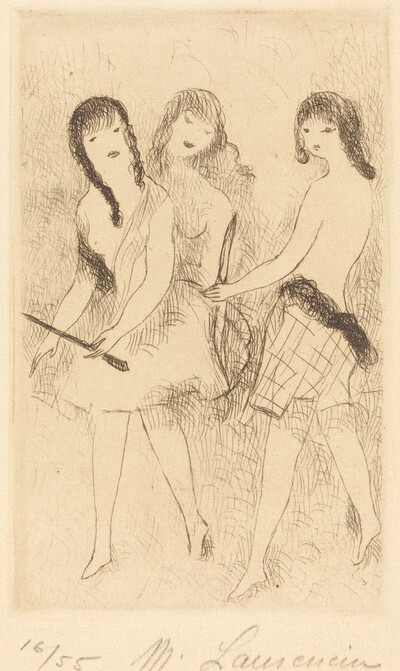
Marie Laurencin (1883-1956) was a French painter known for her delicate, pastel-colored paintings of women and girls in the lyrical, decorative manner that distinguishes her work from the more aggressive styles of her Cubist and Fauve contemporaries. Girl with a Dove from 1928 depicts a young woman with a dove in the pastel palette and simplified forms that characterize Laurencin's mature style. The dove—a traditional symbol of peace and innocence—adds a symbolic dimension to the decorative surface that makes Laurencin's paintings simultaneously lyrical and meaningful. The 1928 date places this in Laurencin's most productive period, when she had developed the pastel manner that is her most recognizable contribution to 20th-century painting.
Cultural Impact
Laurencin's Girl with a Dove is important in the history of 20th-century painting because it demonstrates an alternative to the more aggressive styles of Cubism and Fauvism that dominated French painting in the early 20th century. Laurencin's pastel palette and simplified forms create a type of painting that is simultaneously decorative and meaningful—the dove adds a symbolic dimension to the decorative surface—that represents a feminine alternative to the masculine aggression of the Cubist and Fauve styles.
Why It Matters
Girl with a Dove is Laurencin's lyrical alternative to Cubism and Fauvism: a young woman with a dove rendered in pastel palette and simplified forms that create a painting simultaneously decorative and meaningful. The 1928 painting represents a feminine alternative to the masculine aggression of the dominant early 20th-century styles.