Provenance
Artaria and Co., Vienna. Dr. Gottfried Eissler (1862–1924), Vienna, 1910; sold, Vienna, May 6–7, 1925, lot 150. Private collection, Switzerland. Eugene Victor Thaw, New York. Peter Jay Sharp; sold, Salamander Fine Arts, London, to Richard and Mary L. Gray and the Gray Collection Trust, Chicago, Sept. 20, 2006 (promised to the Art Institute of Chicago, 2018); given to the Art Institute of Chicago, 2022.
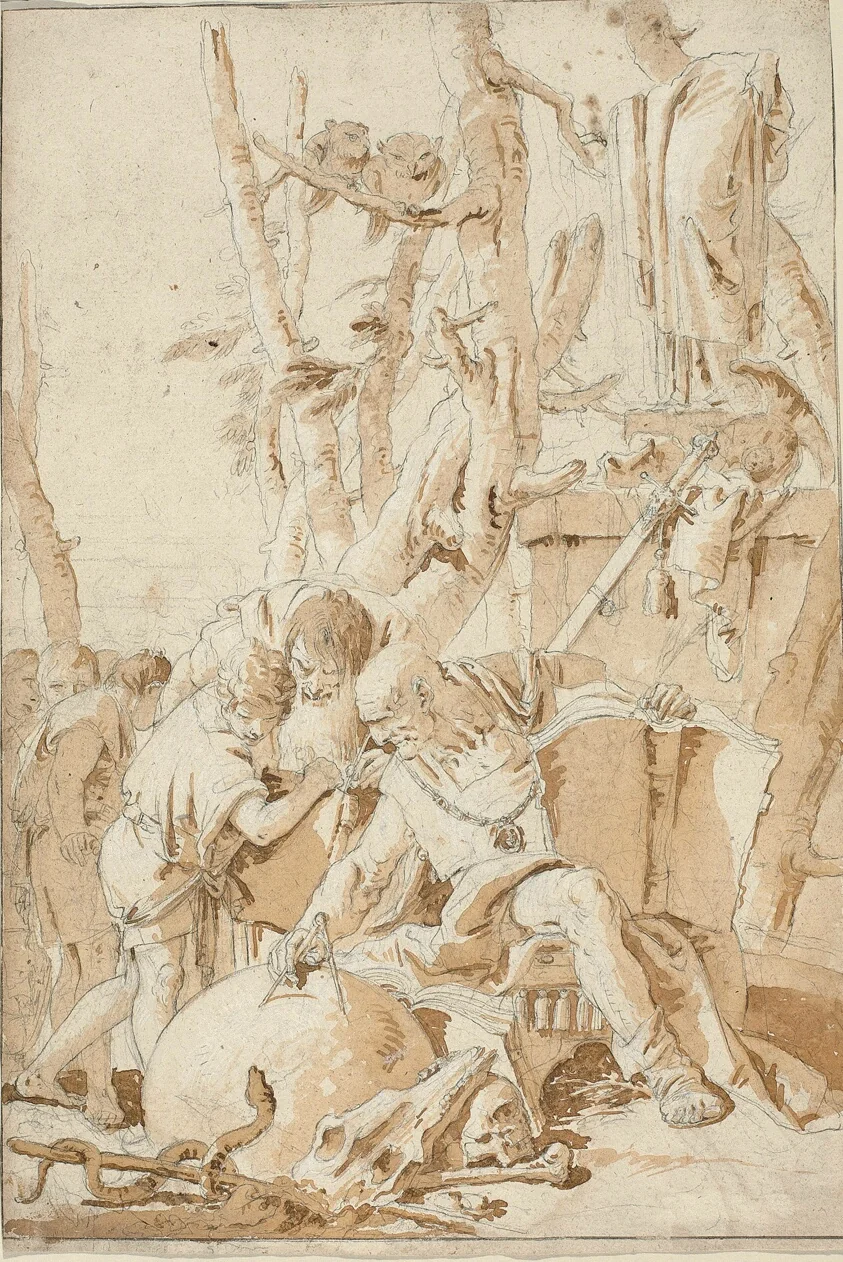
Democritus and Heraclitus Laughing and Sorrowing over the Follies of the World
1742/43
Accession Number
202256
Medium
Black chalk, with pen and black and brown ink and brush and various brown washes, heightened with white gouache, on cream laid paper
Dimensions
40.5 × 27.2 cm (16 × 10 3/4 in.)
Classification
drawings (visual works)
Credit Line
Gift of Richard and Mary L. Gray
Background & Context
Background Story
Giovanni Battista Tiepolo's "Democritus and Heraclitus Laughing and Sorrowing over the Follies of the World" (1742/43) is a drawing in black chalk with pen and black and brown ink and brush and various brown washes, heightened with white gouache on cream laid paper. The subject depicts two ancient Greek philosophers: Democritus, who was known as the "laughing philosopher" for his amused response to human folly, and Heraclitus, the "weeping philosopher" who lamented the same follies. The pairing of these two contrasting responses to the human condition was a popular theme in Renaissance and Baroque art. Tiepolo's treatment is characteristically lively and expressive: Democritus laughs, Heraclitus weeps, their contrasting expressions creating a visual dialogue about the nature of wisdom and the human condition. The combination of media is unusually rich—black chalk, pen and ink, multiple washes, and white gouache—creating a work of extraordinary texture and depth. This drawing is both a philosophical meditation and a display of Tiepolo's unmatched technical virtuosity.
Cultural Impact
Tiepolo's drawing of the two philosophers captures the enduring human dialogue between laughter and tears in the face of life's absurdities, a theme that has resonated from antiquity to the present.
Why It Matters
This extraordinarily rich drawing brings together the laughing and weeping philosophers in a visual dialogue about wisdom and folly, the contrasting expressions rendered with Tiepolo's characteristic brilliance and humanity.


